Tencent Cloud's Cube Sandbox goes fully open source with five technical breakthroughs, providing a production-grade foundation for AI Agent deployment at industrial scale.
SHENZHEN, China, April 23, 2026 /PRNewswire/ -- As AI Agent applications evolve rapidly, building an optimal underlying architecture has become one of the industry's most pressing challenges. On April 21, 2026, Tencent Cloud officially introduced its open-sourced Cube Sandbox under Apache 2.0—not SDK-only, but the entire production-grade sandbox-as-a-service stack, battle-tested at scale and immediately deployable.
A Foundational Layer for the Agent Era
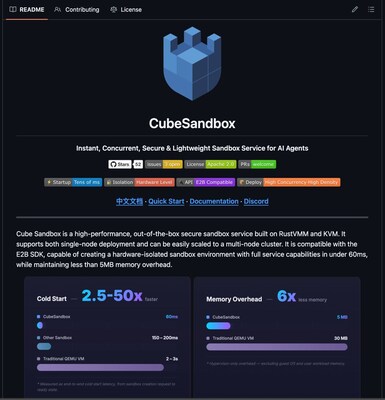
Cube is the industry's only open-source Agent sandbox combining hardware-level isolation with sub-60ms cold start, natively supporting the OpenAI Python SDK and E2B SDK. Developers can simply redirect the runtime and migrate seamlessly. No code changes required.
This gives developers and enterprises a secure, high-performance, low-cost foundation—bringing Agents from the lab into mass production.
Performance, Security, and Stability at the Limit
Built at the hardware virtualization layer, Cube Sandbox delivers an extreme combination:
Five Breakthroughs: A Hardware-Level Security Cockpit for Agents
Built on MicroVM architecture, Cube addresses autonomous Agent security risks: malicious code execution, data exfiltration, resource abuse, and kernel escape.
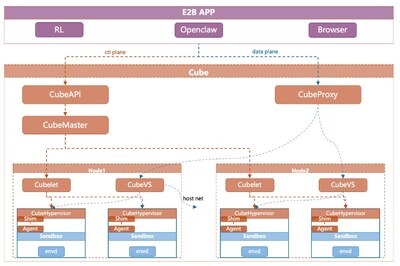
At the technical core, Cube Sandbox delivers five breakthroughs:
Every sandbox runs a dedicated Guest OS kernel via KVM hardware virtualization—no shared kernel. "A breach in one sandbox leaves the rest untouched."
Via resource pool pre-provisioning, snapshot cloning, EPT Lazy Load, and lock optimization, cold start is <60ms (avg. 67ms, P95 = 90ms at 50 concurrent)—significantly outperforming VMs, containers and peer MicroVM solutions.
Per-instance memory overhead <5MB. CoW sharing, Rust-based trimming, and reflink disk sharing enable 2,000+ sandboxes on a single 96-vCPU host, with 90%+ storage savings versus traditional approaches.
Distributed scheduling and bin-packing deliver platform-level burst scheduling of 100K+ instances, with P99 latency below 200ms under 100 concurrent launches on a single 96-vCPU host.
Sub-hundred-millisecond snapshots support checkpoint saving, arbitrary state rollback, and rapid forking. This capability will be released and open-sourced once development is completed.
Three User Scenarios Across the Full Agent Lifecycle
Cube Sandbox addresses the full-lifecycle needs of AI Agents—from R&D and training to application development and enterprise-scale production.
For Foundation Model Labs:
Cube tackles extreme concurrency in Agentic RL training. MiniMax runs hundreds of thousands of heterogeneous sandboxes (Linux, Windows, Android) concurrently. Cube's image acceleration cuts storage and IO pressure; distributed scheduling delivers 100K+ instances per minute, several times faster than peer solutions.
For Agent Developers and Small-to-Medium Businesses:
No Kubernetes, no vendor lock-in—a one-click script sets up the full environment in minutes. Integration via MCP, API, SDK, or CLI requires zero rewrites to Agent code.
For Enterprise Customers:
Full private deployment keeps data within enterprise boundaries, meeting cybersecurity grading and compliance requirements. Apache 2.0 ensures commercial friendliness, full auditability, and zero dependency on foreign cloud providers.
Already Open, Already in Production
Cube Sandbox has released its full codebase, one-click deployment scripts, documentation, and examples—covering Shell execution, file operations, browser automation, RL training, and more—free to use, modify, and distribute.
At the Tencent Cloud Shanghai City Summit on March 27, Dowson Tong, Senior Executive Vice President of Tencent and CEO of the Cloud and Smart Industries Group, first disclosed the Cube open-source plan as a core practice of Tencent Cloud's AI Agent Infrastructure strategy.
Tencent Cloud will pair Cube with TACO AI Acceleration Engine and FlexKV cache system, building a full-stack "Secure Sandbox + Inference Acceleration + Cache Optimization" infrastructure—giving every Agent a secure, efficient, low-cost runtime and unlocking the productivity potential of the large-model era.
Photo - https://mma.prnewswire.com/media/2963963/image1.jpg
Photo - https://mma.prnewswire.com/media/2963962/image2.jpg
 View original content:https://www.prnewswire.co.uk/news-releases/tencent-cloud-cube-sandbox-goes-fully-open-source-with-five-major-breakthroughs-enabling-large-scale-agent-deployment-302751546.html

Die Kursaal Bern AG hat im Geschäftsjahr 2025 in einem anspruchsvollen Umfeld weniger umgesetzt und verdient, hält aber an ihrer Dividendenpolitik fest. Der Verwaltungsrat will der Generalversammlung vom 6. Juni eine unveränderte Ausschüttung von 22 Franken pro Aktie vorschlagen. Der Betriebsertrag der Gruppe aus Gastronomie, Hotellerie, Casinos und Events sank um 2,5 Prozent auf 74,7 Millionen Franken. Das EBITDA ging auf 12,4 Millionen Franken zurück, was einem Rückgang von 5,3 Prozent entspricht, das anteilige Jahresergebnis fiel um 0,5 Millionen auf 3,7 Millionen Franken.
Trotz rückläufiger Kennzahlen verweist das Unternehmen auf eine weiterhin «sehr gute» EBITDA-Marge. Diese spiegle die Effekte eines strikten Kostenmanagements und von Prozessoptimierungen wider. Die Eigenkapitalquote erhöhte sich erneut und lag Ende 2025 bei 70,3 Prozent, ein Plus von 2,5 Prozentpunkten gegenüber dem Vorjahr. Gleichzeitig wurde die Belegschaft angepasst: Die Zahl der Vollzeitstellen verringerte sich um 15 auf 382.
Operativ stand das Jahr im Zeichen besonderer Belastungen. In der Stadt Bern führte die baubedingte Sperrung der Kornhausbrücke zu geringeren Frequenzen in der Gastronomie und drückte die Umsätze in den klassischen Betrieben. Zudem schwächte sich der Markt für terrestrische Casinos ab: Das Grand Casino Kursaal Bern und das Casino Neuenburg verzeichneten einen Rückgang des Bruttospielertrags. Gegengewichte setzten die digitalen Angebote – insbesondere das Onlinecasino 7melons.ch, das ein «erfreuliches Wachstum» erzielte – sowie das Hotelgeschäft, das im Swissôtel Kursaal Bern dank steigender durchschnittlicher Zimmerpreise und der Rolle als UEFA-Host-Hotel bei der Frauenfussball-Europameisterschaft zusätzliche Aufmerksamkeit erhielt.
Strategisch treibt die Gruppe die technologische und digitale Erneuerung voran. Ende 2025 wurde die Technikpartnerschaft an die IDS Group vergeben, zu der unter anderem Kilchenmann AG und auviso AG gehören. Im neuen Modell beteiligt sich die Kursaal Bern AG an den Investitionen in Audio- und Videotechnik; daraus resultierten neu aktivierte immaterielle Vermögenswerte in Höhe von 1,6 Millionen Franken. Parallel dazu forciert das Unternehmen die Digitalisierung interner Abläufe, um Kosten zu senken und die Produktivität zu erhöhen – bei gleichzeitiger Sensibilisierung für Risiken wie Cyberangriffe, Datenverluste und Reputationsschäden.
Für das laufende Jahr zeigt sich die Kursaal Bern AG verhalten zuversichtlich. Trotz geopolitischer Unsicherheiten rechnet die Gruppe mit moderatem Wachstum und will insbesondere das Eventgeschäft mit eigenen Formaten ausbauen, etwa gemeinsam mit dem Berner Kulturlokal Bierhübeli im Kultursaal Bern. Dagegen dürfte die Hotellerie laut Unternehmensangaben unter den unsicheren globalen Rahmenbedingungen leiden, weshalb mit Belastungen in diesem Segment gerechnet wird.