Highest recognition highlights Quantifind's AI-native approach to KYC, adverse media screening, and next-generation financial crime compliance
PALO ALTO, Calif., July 8, 2026 /PRNewswire/ -- Quantifind, the leader in AI-native Risk Intelligence for financial crime and national security, today announced it has been named a Luminary in Celent's Know Your Customer Systems: Adverse Media Screening Technology Capabilities Matrix and 2026 XCelent Awards.
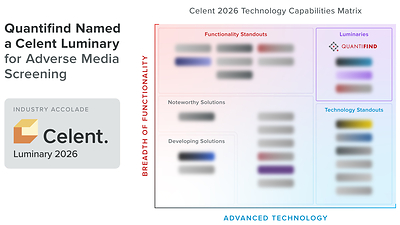
The Luminary designation is Celent's highest level of recognition within its Technology Capabilities Matrix and is awarded to solutions that demonstrate exceptional innovation, technology leadership, and product capabilities.
Recognized for AI-native Innovation
"Independent recognition from Celent reinforces what our customers experience every day," said Graham Bailey, COO of Quantifind. "As financial crime becomes more sophisticated and compliance teams face increasing investigative workloads, AI-native risk intelligence has become essential. We're honored that Celent recognized Quantifind's ability to help institutions identify meaningful risk faster while improving operational efficiency."
Purpose-built for Modern Risk Operations
Adverse media has become one of the fastest-growing and most operationally challenging components of Know Your Customer (KYC), anti-money laundering (AML), and fraud prevention programs. Financial institutions must continuously monitor millions of news articles, sanctions updates, government records, and open-source intelligence while distinguishing meaningful risk from overwhelming amounts of noise.
The Graphyte™ AI-native Risk Intelligence Platform was purpose-built for this challenge.
At its core is Quantifind's Agentic Middleware, which orchestrates AI agents on top of trusted risk intelligence, enabling organizations to deploy AI-powered investigations rapidly without building complex workflows from scratch. By combining advanced entity resolution, Name Science™, dynamic risk typologies, explainable AI, and comprehensive open-source intelligence with governed agentic execution, Quantifind helps financial institutions rapidly deploy AI-powered investigations while maintaining transparency, auditability, and human oversight.
This architecture enables organizations to realize value faster, accelerating implementation timelines while reducing manual investigations and improving the consistency and quality of risk decisions.
Unlike traditional keyword or rules-based screening, Graphyte understands entities, relationships, context, and evolving risk signals to produce explainable, high-confidence risk assessments at enterprise scale.
The same AI-native platform supports a broad range of financial crime operations, including:
Delivering Measurable Business Impact
The technology recognized by Celent is already delivering measurable operational improvements for financial institutions.
Organizations using Quantifind have reported:
Earlier this year, separate independent research conducted by Celent found that AI-driven financial crime operations can deliver up to $177.9 million in annual operational savings for a Tier 1 financial institution across KYC and sanctions screening, underscoring the growing business value of AI-native risk intelligence.
Built for the Next Generation of Compliance
Quantifind continues to expand its Agentic Middleware capabilities across the Graphyte platform, enabling financial institutions to automate portions of the investigative workflow while maintaining human oversight, explainability, and policy-driven governance.
Rather than simply generating answers, Quantifind's AI-native platform delivers structured, auditable risk intelligence that enables financial institutions to investigate more efficiently, improve consistency across analysts, and scale compliance operations without sacrificing quality or regulatory confidence.
Continuous Industry Recognition
The Celent Luminary designation follows a series of independent industry recognitions highlighting Quantifind's leadership in AI-native financial crime technology, including its recent placement among the Top 10 Core Technology providers in the 2026 Chartis Financial Crime and Compliance 50 report, along with category awards for Perpetual KYC and Open-source and Unstructured Data Processing.
Together, these independent recognitions reflect Quantifind's continued leadership in helping financial institutions modernize financial crime compliance with AI-native technology built for today's rapidly evolving risk landscape.
About Quantifind
Quantifind is the leader in AI-native Risk Intelligence for modern risk operations. We deliver purpose-built solutions that transform how financial institutions and government agencies detect, assess, and mitigate financial crime and national security threats — including the complex networks that enable illicit finance, corruption, sanctions evasion, trafficking, and terrorism.
The Graphyte™ AI-native Risk Intelligence Platform unifies internal, third-party, and open-source data into a single, high-accuracy risk intelligence system powered by advanced entity resolution, Name Science™, dynamic risk typologies, and real-time network graph intelligence. Customers leverage the power of Graphyte accuracy, speed, and scale for KYC, Sanctions, Payments Transaction Intelligence, Investigations and Third-party risk management.
Contact us to learn how Quantifind empowers precise, mission-aligned intelligence at speed and scale.
Media Contact:
Annalisa Camarillo, CMO
contact@quantifind.com

 View original content to download multimedia:https://www.prnewswire.co.uk/news-releases/quantifind-named-a-celent-luminary-for-adverse-media-screening-technology-302820381.html

Die Einigung zwischen den USA und dem Iran auf ein Rahmenabkommen zur Beendigung des Iran-Kriegs sorgt in der Handelsschifffahrt für vorsichtige Erleichterung. Besonders im Fokus steht die Straße von Hormus, eine der wichtigsten Seepassagen für den weltweiten Öl- und Flüssiggas-Handel. Seit Beginn des Konflikts Ende Februar ist die Meerenge weitgehend blockiert, zahlreiche Handelsschiffe sitzen im Persischen Golf fest. Nun soll die Passage nach der geplanten Unterzeichnung des Abkommens wieder geöffnet werden.
US-Präsident Donald Trump kündigte an, dass die Straße von Hormus nach dem Abschluss der Vereinbarung wieder für den Verkehr freigegeben werden solle. Die Unterzeichnung ist für Freitag in Genf vorgesehen. Für die deutsche Handelsschifffahrt wäre dies ein entscheidender Schritt zur Normalisierung. „Die Signale aus den Gesprächen zwischen den USA und dem Iran machen auch der Schifffahrt Hoffnung“, sagte Martin Kröger, Hauptgeschäftsführer des Verbands Deutscher Reeder (VDR). Zugleich mahnte er, es müsse sich erst zeigen, ob die Passage dauerhaft sicher befahrbar sein werde. Man sei „vorsichtig optimistisch“.
Die Branche hat allen Grund, auf rasche Entspannung zu hoffen. Nach Angaben des VDR sitzen aktuell noch 46 Schiffe deutscher Reedereien mit rund 1.000 Seeleuten im Persischen Golf fest. Die Blockade der Meerenge trifft nicht nur die Reedereien, sondern bremst den globalen Energiehandel. Die UN-Sonderorganisation für Seeschifffahrt (IMO) begrüßte die Einigung ausdrücklich. Seit Ausbruch des Konflikts wurden der IMO zufolge 46 Angriffe auf Handelsschiffe in der Region bestätigt, bei denen 14 Seeleute ums Leben kamen.
Trotz der diplomatischen Fortschritte sehen Branchenverbände die Lage in der Region weiter kritisch. Der internationale Schifffahrtsverband Bimco bewertet die Sicherheitslage in der Straße von Hormus auch nach Bekanntwerden des Rahmenabkommens als instabil. Eine Durchfahrt bleibe sehr riskant, heißt es aus dem Verband. Für Reeder und Charterer stellt sich damit die Frage, wie schnell und in welchem Umfang sie ihre Routen wieder über die Meerenge führen können – oder ob Ausweichrouten zumindest mittelfristig bestehen bleiben müssen.
Für den Moment überwiegt in der Schifffahrt die Hoffnung, dass die geplante Vereinbarung in Genf die Voraussetzungen für eine nachhaltige Entspannung an einem der neuralgischsten Punkte des globalen Seehandels schafft. Ob und wie schnell sich die Zahl der festliegenden Schiffe reduziert und sich die Risikoeinschätzungen der Versicherer und Verbände anpassen, dürfte entscheidend dafür sein, wann sich der Verkehr durch die Straße von Hormus wieder weitgehend normalisiert.