PARIS, June 11, 2026 /PRNewswire/ -- Orqa - Europe's leading developer and manufacturer of drones made without Chinese components - today announces the launch of the MRM2-10AI, a next-generation tactical drone purpose-built for contested battlefield environments and the realities of modern electronic warfare.
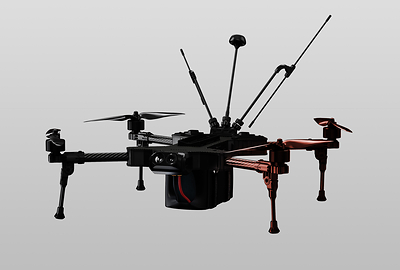
With armed forces increasingly facing radio-frequency jamming, GNSS disruption, and electronic attack, the MRM2-10AI sets a new standard in resilient communications, intelligent autonomy, and mission continuity, enabling it to succeed where conventional drone systems struggle.
At the heart of the platform is a hybrid communications architecture combining Orqa's proven IRONghost radio control system with native fiber-optic integration and automatic communications failover. This enables the MRM2-10AI to use either communication method without platform reconfiguration and instantly transition to the radio-frequency link if the fiber-optic connection is broken.
The MRM2-10AI features a powerful new Auto Pilot Board that unlocks a series of cutting-edge autonomous capabilities, including vision-based terminal guidance for GNSS-denied operations, advanced computer vision applications, battlefield analytics, and collaborative multi-drone operations.
A fully open development architecture and a supported third-party Developer Program (developer.orqafpv.com) provides a foundation for AI capabilities and software solutions, while ATAK compatibility supports seamless integration with existing battlefield management and situational awareness systems.
"As the nature of warfare continues to evolve, drone operators require systems that can remain effective in contested spaces," said Srdjan Kovacevic, co-founder and CEO of Orqa. "The MRM2-10AI combines resilient communications, onboard intelligence, and autonomous capability in a platform designed to keep missions moving. It represents the next step in tactical drone capability for today's armed forces."
Available in multiple configurations to meet a variety of mission requirements - including variants equipped with advanced thermal imaging and enhanced processing capabilities - the MRM2-10AI is being officially launched at Eurosatory 2026, the global event for defence and security in Paris.
 View original content to download multimedia:https://www.prnewswire.co.uk/news-releases/orqa-unveils-the-mrm2-10ai-at-eurosatory-a-tactical-drone-designed-to-dominate-in-the-age-of-electronic-warfare-302797302.html

Der Standortentscheid ist gefallen: Hitachi Energy baut seinen neuen Schweizer Hauptsitz nicht in Wettingen AG, sondern in Otelfingen im Kanton Zürich. Der international tätige Technologiekonzern will auf einem Campus das bisher über zwölf Standorte verteilte Geschäft in der Schweiz konzentrieren und dort langfristig rund 3000 Arbeitsplätze ansiedeln. Bereits heute sichert das Unternehmen nach eigenen Angaben 1000 Stellen, zusätzlich sollen auf dem neuen Areal bis zu 2000 weitere Jobs entstehen.
Otelfingen setzt sich damit gegen die Aargauer Gemeinde Wettingen durch, die auf der «grünen Wiese» im Gebiet Tägerhardächer auf die Ansiedlung gehofft hatte. Statt eines kompletten Neubaus nutzt Hitachi in Otelfingen das ehemalige, teils unter Schutz stehende Jelmoli-Verteilzentrum sowie angrenzende Parzellen – insgesamt 11 Hektaren. Ausschlaggebend waren nach Angaben der Beteiligten unter anderem die bestehende S-Bahn-Haltestelle direkt beim Areal, die Möglichkeit einer etappierten Entwicklung des Projekts sowie die Risikoabwägung zwischen Umnutzung bestehender Bausubstanz und einem Neubau.
Für Otelfingen markiert der Entscheid einen Einschnitt von historischer Dimension: Die Gemeinde vergleicht die Ansiedlung der Energie-Sparte von Hitachi mit dem Zuzug von Jelmoli in den 1960er-Jahren. Der Campus soll zunächst mit rund 1600 Arbeitsplätzen starten und später auf bis zu 3000 ausgebaut werden. Hitachi Energy plant, bis 2030 die heutigen Standorte in Baden, Dättwil, Turgi-Untersiggenthal, Seon und Zürich-Altstetten in Otelfingen zu bündeln. Der Konzern bekräftigt, die Schweiz bleibe ein entscheidendes Zentrum für die Weiterentwicklung seiner Technologien.
Im Aargau überwiegen Enttäuschung und Sorge. Rund 1000 Arbeitsplätze gehen dem Kanton mit der Verlagerung verloren, wie die Standortförderung bestätigt. Wettingen hatte sich von dem Projekt nicht nur Impulse für das wirtschaftlich angeschlagene Gemeinwesen, sondern auch bis zu zweistellige Millionenerträge pro Jahr in der Gemeindekasse erhofft. Gleichzeitig war das Vorhaben politisch umstritten: Für den geplanten Campus hätte Landwirtschaftsland umzoned werden müssen, wogegen sich insbesondere die Nachbargemeinde Würenlos stellte und unter anderem steigende Immobilienpreise und mehr Verkehr befürchtete. Dass nun Otelfingen mit bestehender Infrastruktur und höherer Unternehmenssteuerbelastung den Zuschlag erhält, verschiebt das wirtschaftliche Gewicht in der Region Limmattal zugunsten des Kantons Zürich.