CLARK, N.J., April 10, 2026 /PRNewswire/ -- GEP Global Supply Chain Volatility Index — a leading indicator tracking demand conditions, shortages, transportation costs, inventories and backlogs, based on a monthly survey of 27,000 businesses — signaled that global supply chain pressures rose to a three-year high in March, reflecting the immediate economic impact of the energy price shock and maritime disruption caused by the war in the Middle East.
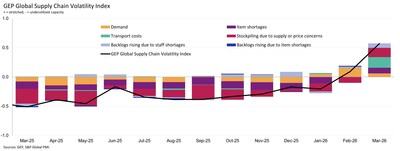
The GEP Global Supply Chain Volatility Index soared from 0.09 in February to 0.57 in March, its highest level since January 2023.
In March, global manufacturers increase safety stockpiling in response to maritime disruption, higher transportation costs and supplier price increases. Reports of inventory buffers being accumulated were the highest in three years, with increases across all major regions.
Uncertainty resulting from the conflict weighed on manufacturers' input demand, with factories around the world cutting purchasing volumes. Notably, item shortages hit a three-year high despite slowing demand, signaling the emergence of bottlenecks, with the availability of materials such as polymers, PVC and rubber, as well as energy-intensive metals such as aluminum and copper reportedly deteriorating the most.
Surging oil prices pushed global transportation costs to a four-year high in March. The impact was felt globally, but especially strongly in Asia, given its reliance on Middle East oil. Taiwan, Vietnam, South Korea and Japan reported surging producer price inflation during March.
"The war is pushing up costs, triggering stockpiling and creating shortages across supply chains, but it has not yet escalated into a broad-based shock that materially slows global economic growth," said Mukund Acharya, vice president, consulting, GEP. "Companies need to secure supply where it matters most while avoiding broad stockpiling that can lock in higher costs."
Interpreting the data:
Index > 0, supply chain capacity is being stretched. The further above 0, the more stretched supply chains are.
Index < 0, supply chain capacity is being underutilized. The further below 0, the more underutilized supply chains are.
Interpreting the data:
Index > 0, supply chain capacity is being stretched. The further above 0, the more stretched supply chains are.
Index < 0, supply chain capacity is being underutilized. The further below 0, the more underutilized supply chains are.
MARCH 2026 REGIONAL KEY FINDINGS
MARCH 2026 KEY FINDINGS
For more information, visit www.gep.com/volatility.
Note: Full historical data dating back to January 2005 is available for subscription. Please contact economics@spglobal.com.
The next release of the GEP Global Supply Chain Volatility Index will be 8 a.m. ET, May 12, 2026.
About the GEP Global Supply Chain Volatility Index
The GEP Global Supply Chain Volatility Index is produced by S&P Global and GEP. It is derived from S&P Global's PMI® surveys, sent to companies in over 40 countries, totaling around 27,000 companies. The headline figure is a weighted sum of six sub-indices derived from PMI data, PMI Comments Trackers and PMI Commodity Price & Supply Indicators compiled by S&P Global.
A Supply Chain Volatility Index is also published at a regional level for Europe, Asia, North America and the U.K. For more information about the methodology, click here.
Media Contacts
Derek Creevey | Joe Hayes | S&P Global Market Intelligence |
Director, Public Relations | Principal Economist | Corporate Communications |
GEP | S&P Global Market Intelligence | Email: Press.mi@spglobal.com |
Phone: +1 646-276-4579 | Phone: +44-1344-328-099 | |
Email: derek.creevey@gep.com | Email: joe.hayes@spglobal.com |
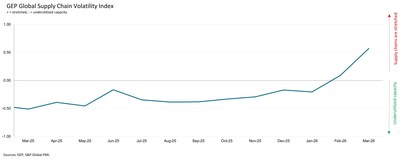
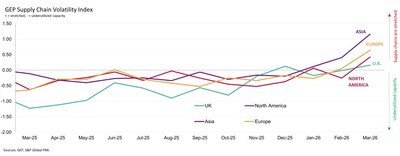

Photo - https://mma.prnewswire.com/media/2953258/GEP_SCVI_breakdown.jpg
Photo - https://mma.prnewswire.com/media/2953259/GEP_SCVI_headline.jpg
Photo - https://mma.prnewswire.com/media/2953260/SCVI_ALL.jpg
Logo - https://mma.prnewswire.com/media/518346/GEP_Logo.jpg
 View original content:https://www.prnewswire.co.uk/news-releases/middle-east-war-drives-global-supply-chain-pressures-to-a-three-year-high-gep-global-supply-chain-volatility-index-302738828.html

Sexuelle Gewalt hinterlässt bei den Betroffenen deutlich tiefere und länger anhaltende Spuren, als bislang in der Schweiz weithin angenommen. Das zeigt eine neue Studie aus der Romandie, die vom Genfer Universitätsspital (HUG) koordiniert wurde und nach Angaben der Forschenden erstmals eine systematische Nachverfolgung von Opfern über einen Zeitraum von zwölf Monaten vornimmt. Beteiligt waren neben dem HUG der Spitalverbund Wallis sowie fünf Waadtländer Spitäler.
Für die Untersuchung wurden 181 von sexueller Gewalt betroffene Personen – 180 Frauen und ein Transmann – ein Jahr lang begleitet. Die Auswertung ergibt ein klares Bild: 71 Prozent der Teilnehmenden zeigen zwölf Monate nach der Tat depressive Symptome, 68 Prozent weisen Anzeichen einer posttraumatischen Belastungsstörung auf, 57 Prozent leiden unter ausgeprägter Angst. Mehr als die Hälfte der Befragten berichtet zudem weiterhin über körperliche Beschwerden wie chronische Schmerzen, Schlafstörungen oder anhaltende Erschöpfung.
Besonders gravierend sind die Folgen im Intimbereich. Rund zwei Drittel der Betroffenen, die sexuell aktiv sind, geben an, auch ein Jahr nach dem Übergriff unter sexuellen Funktionsstörungen zu leiden. „Diese Daten zeigen klar, dass sexuelle Gewalt ein tiefgreifendes und dauerhaftes Trauma ist“, wird Studienleiterin Jasmine Abdulcadir in der Mitteilung zur Studie zitiert. Die Ergebnisse deuten darauf hin, dass es sich nicht um vorübergehende Reaktionen handelt, sondern um anhaltende Beeinträchtigungen mit potenziell weitreichenden Auswirkungen auf Partnerschaft, Familie und Berufsleben.
Die Datenerhebung bestätigt zudem bekannte Muster bei sexueller Gewalt. In der Mehrheit der Fälle kennen die Betroffenen die Täterperson, häufig stammt diese aus dem nahen Umfeld. Die gemeldeten Übergriffe ereignen sich überwiegend in privaten Räumen. Zwar suchen viele Opfer laut Studie rasch nach der Tat medizinische Hilfe, doch die Forschenden verweisen darauf, dass die anschliessende Betreuung häufig unzureichend bleibt. Angesichts der hohen Belastung über mindestens ein Jahr hinweg sehen Fachleute dringenden Handlungsbedarf bei der langfristigen psychischen, körperlichen und sexuellen Versorgung von Betroffenen.