VIENNA, May 21, 2026 /PRNewswire/ -- MGI Tech Co., Ltd. (MGI), a company committed to developing core tools and technologies that drive innovation in life sciences, presented its latest advancements in laboratory automation and integrated workflow solutions at SLAS 2026 in Vienna, Austria.
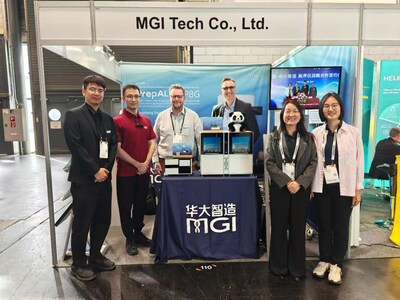
At this year's event, MGI Tech highlighted a portfolio of intelligent automation and multi-omics solutions designed to accelerate research efficiency, simplify complex workflows, and empower emerging applications in proteomics and integrated laboratory automation.
PrepALL-pP8G: Advancing Single-Cell Proteomics Automation
As an extension of the PrepALL platform, PrepALL-pP8G expands its application into the field of single-cell proteomics, primarily for sample pretreatment. A key attribute of the PrepALL platform is its inherent flexibility, allowing seamless integration with external devices to broaden its application scope,of which the PrepALL-pP8G is a prime example. Designed to highly automate and streamline complex proteomics workflows, the system combines thermal inkjet printing technology with high-precision ultra-low volume dispensing to enable a fully integrated workflow from single-cell sorting to proteomics sample preparation. The official European launch is expected in the second half of this year.
Featuring 640 independent parallel nozzles and advanced AI-assisted camera vision recognition, the PrepALL-pP8G enables ultra-high throughput processing of 384-well plates in just minutes while preserving cell viability and protein integrity through gentle, electrical-deflection-free sorting. The platform supports label-free, labeled, and conventional proteomics workflows, making it suitable for applications including tumor heterogeneity research, rare cell analysis, organoid and stem cell research, and multi-omics integration.
GenSIRO48: Enabling Next-Generation Clinical Automation
Making its first international debut, MGI Tech also presented the SIRO48, an advanced fully automated sample processing system designed to deliver a "Sample In, Report Out" solution that accelerates and simplifies complex sample processing workflows. The system integrates nucleic acid purification, fragmentation, end repair, adapter ligation, PCR amplification, and library purification & quality control in a single workflow.
Engineered to evolve from step-by-step manual operations to integrated full-process closed loop, multi-step manual intervention to full-process unattended execution, and low-throughput single-sample processing to high-throughput parallel processing of 48 samples, it is purpose-built for seamless integration into real-world clinical molecular diagnosis, public health prevention and control, and life science research scenarios. This system enables a transformative leap in sequencing library preparation—from "isolated manual operations" to "full-chain intelligent automation".
VisiOmics (PMIF-20RS): Boosting Spatial Proteomics Exploration in Translational Medicine
MGI Tech was also showcasing the PMIF VisiOmics (PMIF-20RS), a fully automated staining and imaging system making its European debut. It leverages multiplex immune fluorescence (mIF) technology to capture precise spatial protein expression data in tissue sections. Integrated with an AI-powered analysis platform for accurate cell segmentation, phenotyping, and spatial mapping, it provides a complete workflow solution for applications in tumor classification, prognosis, tumor microenvironment analysis, and translational research. The official European launch of VisiOmics is also expected to take place in the second half of this year.
Driving the Future of Intelligent Laboratory Automation
"SLAS provides an excellent platform to demonstrate how intelligent automation is transforming life science research and clinical laboratory operations," said a spokesperson for MGI Tech. "Our latest solutions are designed to help laboratories overcome workflow complexity, improve scalability, and accelerate scientific discovery across rapidly evolving research areas such as single-cell proteomics and organoid biology."
About MGI
MGI Tech Co., Ltd. (or its subsidiaries, together referred to as MGI) is committed to building core tools and technologies that drive innovation in life science. Our focus lies in research & development, manufacturing, and sales of instruments, reagents, and related products in the field of life science and biotechnology. We provide real-time, multi-omics, and a full spectrum of digital equipment and systems for precision medicine, agriculture, healthcare, and various other industries.
Founded in 2016, MGI has grown into a leader in life science, serving customers across six continents and establishing research, manufacturing, training, and after-sales service facilities globally. As one of the few companies capable of independently developing and mass-producing clinical-grade gene sequencers, MGI empowers global users with scalable sequencing capabilities ranging from Gb to Tb levels. MGI also stands out as one of the only providers of a full-stack product portfolio that spans three core segments: SEQ ALL (short- and long-read sequencing), GLI (Generative Lab Intelligence), and Multi-Omics. With unparalleled expertise, cutting-edge products, and a commitment to global impact, MGI continues to shape the trajectory of life sciences into the future.
To learn more, please visit MGI Tech, LinkedIn, X, Instagram, and YouTube.
Photo - https://mma.prnewswire.com/media/2985570/SLAS_Group_Photo.jpg
 View original content:https://www.prnewswire.co.uk/news-releases/mgi-tech-showcases-next-generation-laboratory-automation-and-multi-omics-solutions-at-slas-2026-302779389.html

Die Einigung zwischen den USA und dem Iran auf ein Rahmenabkommen zur Beendigung des Iran-Kriegs sorgt in der Handelsschifffahrt für vorsichtige Erleichterung. Besonders im Fokus steht die Straße von Hormus, eine der wichtigsten Seepassagen für den weltweiten Öl- und Flüssiggas-Handel. Seit Beginn des Konflikts Ende Februar ist die Meerenge weitgehend blockiert, zahlreiche Handelsschiffe sitzen im Persischen Golf fest. Nun soll die Passage nach der geplanten Unterzeichnung des Abkommens wieder geöffnet werden.
US-Präsident Donald Trump kündigte an, dass die Straße von Hormus nach dem Abschluss der Vereinbarung wieder für den Verkehr freigegeben werden solle. Die Unterzeichnung ist für Freitag in Genf vorgesehen. Für die deutsche Handelsschifffahrt wäre dies ein entscheidender Schritt zur Normalisierung. „Die Signale aus den Gesprächen zwischen den USA und dem Iran machen auch der Schifffahrt Hoffnung“, sagte Martin Kröger, Hauptgeschäftsführer des Verbands Deutscher Reeder (VDR). Zugleich mahnte er, es müsse sich erst zeigen, ob die Passage dauerhaft sicher befahrbar sein werde. Man sei „vorsichtig optimistisch“.
Die Branche hat allen Grund, auf rasche Entspannung zu hoffen. Nach Angaben des VDR sitzen aktuell noch 46 Schiffe deutscher Reedereien mit rund 1.000 Seeleuten im Persischen Golf fest. Die Blockade der Meerenge trifft nicht nur die Reedereien, sondern bremst den globalen Energiehandel. Die UN-Sonderorganisation für Seeschifffahrt (IMO) begrüßte die Einigung ausdrücklich. Seit Ausbruch des Konflikts wurden der IMO zufolge 46 Angriffe auf Handelsschiffe in der Region bestätigt, bei denen 14 Seeleute ums Leben kamen.
Trotz der diplomatischen Fortschritte sehen Branchenverbände die Lage in der Region weiter kritisch. Der internationale Schifffahrtsverband Bimco bewertet die Sicherheitslage in der Straße von Hormus auch nach Bekanntwerden des Rahmenabkommens als instabil. Eine Durchfahrt bleibe sehr riskant, heißt es aus dem Verband. Für Reeder und Charterer stellt sich damit die Frage, wie schnell und in welchem Umfang sie ihre Routen wieder über die Meerenge führen können – oder ob Ausweichrouten zumindest mittelfristig bestehen bleiben müssen.
Für den Moment überwiegt in der Schifffahrt die Hoffnung, dass die geplante Vereinbarung in Genf die Voraussetzungen für eine nachhaltige Entspannung an einem der neuralgischsten Punkte des globalen Seehandels schafft. Ob und wie schnell sich die Zahl der festliegenden Schiffe reduziert und sich die Risikoeinschätzungen der Versicherer und Verbände anpassen, dürfte entscheidend dafür sein, wann sich der Verkehr durch die Straße von Hormus wieder weitgehend normalisiert.