SHANGHAI, June 5, 2026 /PRNewswire/ -- JA ESS launched JAPlanet Fusion, its latest 125kW/261kWh commercial and industrial (C&I) hybrid solar-plus-storage system. Designed for factories, industrial parks, commercial facilities, public infrastructure and EV charging stations, JAPlanet Fusion is built to simplify solar-plus-storage deployment, increase on-site renewable energy utilization and support more intelligent energy management.
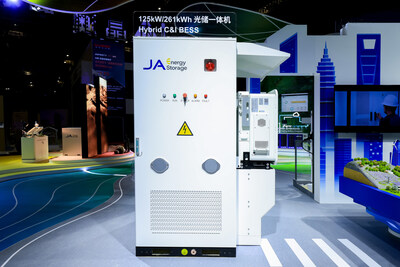
JAPlanet Fusion is a DC-coupled hybrid system developed for C&I projects with high on-site solar consumption. The system supports up to 250kW of PV input and integrates PV access, energy storage conversion, on-grid/off-grid switching and energy management into one coordinated platform. By reducing the need for a separate PV inverter, the product helps simplify system configuration, shorten installation work and improve overall system efficiency.
The integrated architecture enables closer coordination among solar generation, battery storage, grid interaction and load demand. For C&I users operating under changing electricity tariffs and variable load profiles, JAPlanet Fusion can support higher solar self-consumption, more flexible energy scheduling and stronger power reliability. The system is suitable for applications including solar self-consumption, backup power, microgrids and solar-storage-charging scenarios.
Safety and long-term reliability are central to the product design. JAPlanet Fusion adopts a system-level safety architecture covering the battery system, power conversion and energy management, with coordinated monitoring and protection functions. The product also supports intelligent operation through JA ESS's digital capabilities, helping users monitor system status, identify abnormalities and manage assets more efficiently throughout the lifecycle.
JAPlanet Fusion reflects JA ESS's broader view of C&I energy storage: storage is no longer only about charging and discharging electricity. It is becoming an integrated energy management asset that connects renewable generation, load control, grid interaction and digital operation. Through this approach, C&I users can better respond to energy cost pressure, renewable energy consumption needs and power reliability requirements.
To support intelligent operation, JA ESS connects its product portfolio with JA Nebula™, the company's digital energy platform. JA Nebula™ supports AI monitoring, operating data collection, intelligent alerts, remote diagnostics and maintenance management, helping improve system visibility, operation efficiency and long-term asset management.
JAPlanet Fusion is part of JA ESS's broader Solar + Storage + X solution framework, which integrates solar generation, energy storage, loads, charging infrastructure and digital management across scenarios such as industrial and commercial parks, solar-storage-charging stations, microgrids, agriculture, mining and off-grid energy systems.
Alongside JAPlanet Fusion, JA ESS also introduced the upgraded JAPlanet 2.0, its All-in-One C&I BESS, further enhancing the company's portfolio for peak shaving, demand management, backup power, dynamic capacity expansion and microgrid applications. Visit www.jasolar.com/ess for more product information.
Photo - https://mma.prnewswire.com/media/2995398/pic.jpg
 View original content:https://www.prnewswire.co.uk/news-releases/ja-ess-launches-japlanet-fusion-ci-hybrid-solar-plus-storage-system-302792382.html

Die Inselgruppe hat die umfangreiche Sanierung des Marie-Colinet-Hauses in Bern abgeschlossen und bereitet die Wiedereröffnung des Gebäudes an der Effingerstrasse vor. In das frühere Gebäude der Berner Frauenklinik, das zu den grössten Baudebakeln in der Geschichte des Kantons gezählt wird, ziehen im August die Frauenklinik und die Neonatologie der Kinderklinik ein, im September folgt die Augenklinik. Die Inselgruppe hatte das 2002 bezogene Haus 2007 vom Kanton übernommen und kurze Zeit später festgestellt, dass erneut ein umfassender Umbau nötig wird.
Der Umbau dauerte fünf Jahre und wurde von Verzögerungen und Mehrkosten begleitet. Während der Arbeiten traten zusätzliche Mängel an der Bausubstanz zutage. 2021 wurde bei Abbrucharbeiten Schimmel entdeckt, was zu einem Baustopp und einer Schadstoffsanierung führte. Insgesamt belaufen sich die Kosten der Sanierung auf 230 Millionen Franken, die vollständig von der Inselgruppe finanziert wurden.
Technisch und baulich wurde das Gebäude grundlegend erneuert. Es ist nun erdbebensicher, sämtliche Räume sind klimatisiert, und das Haus wurde um ein Technikgeschoss aufgestockt. Das Fassadenbild musste dabei unverändert bleiben, die "Transformation fand innen statt", wie Abel Müller-Hübenthal, Direktor Immobilien und Betrieb der Inselgruppe, anlässlich eines Medienrundgangs erklärte. Für die Sanierung wurde das Marie-Colinet-Haus bis auf seine Primärstruktur zurückgebaut.
Die Inselgruppe nutzte das Projekt auch für eine funktionale Neuordnung. Frauenklinik, Wochenbettstation und neonatologische Versorgung rücken räumlich näher zusammen, um die Wege zwischen den Abteilungen zu verkürzen. Zudem reagierten die Planer auf Rückmeldungen aus der Eröffnungsphase von 2002, als sich Betroffene über eine als kalt empfundene Atmosphäre beklagt hatten. Im Innern kommen nun unterschiedliche Farbtöne und Holzelemente zum Einsatz, um ein freundlicheres Umfeld für Patientinnen, Patienten und Personal zu schaffen.