SEOUL, South Korea, April 30, 2026 /PRNewswire/ -- Hyundai Motor Group (the Group) today unveiled Pleos Connect, a next-generation in-vehicle infotainment system designed to fundamentally transform the customer mobility experience.
As the first major step in the Group's transformation into a software-centric mobility leader, Pleos Connect is built on three core development pillars—intuitiveness, safety, and openness—to combine a mobile-friendly user environment with advanced artificial intelligence (AI), creating a highly scalable and intuitive platform. The system will receive continuous feature and performance enhancements via over-the-air (OTA) software updates.
The system will debut on the Group's new vehicles later this year in Korea. The Group aims to equip approximately 20 million Hyundai, Kia and Genesis vehicles with Pleos Connect by 2030, reinforcing its leadership in future mobility solutions.

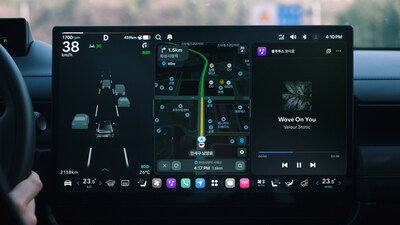
The Pleos Connect cockpit features two main displays:
Driver safety is enhanced through the physical buttons on the steering wheel and below the Large Central Screen, allowing quick access to key controls without using the touchscreen. In addition, a three‑finger gesture allows drivers to easily reposition app windows or instantly close unnecessary apps, supporting safer and more convenient interaction with in-vehicle applications.
At the heart of Pleos Connect is Gleo AI, an advanced voice assistant built on a large language model (LLM). The system is scheduled to be linked with a variety of application services, enabling customers to seamlessly use a wide range of app functions with voice commands alone.
More information about Hyundai Motor Group can be found at: http://www.hyundaimotorgroup.com or Newsroom: Media Hub by Hyundai, Kia Global Newsroom, Genesis Newsroom
Photo - https://mma.prnewswire.com/media/2970125/Image_1.jpg
Photo - https://mma.prnewswire.com/media/2970126/Image_2.jpg
PDF - https://mma.prnewswire.com/media/2970127/Press_Release__Hyundai_Motor_Group_Pleos_Connect_Next_Generation_Infotainment_System_vF_wire.pdf
 View original content to download multimedia:https://www.prnewswire.co.uk/news-releases/hyundai-motor-group-redefines-in-vehicle-experience-with-pleos-connect-next-generation-infotainment-system-302758637.html

Im Gotthardmassiv im Tessin ist einem internationalen Forschungsteam erstmals gelungen, die Erde kontrolliert zum Beben zu bringen. Im Untergrundlabor "Bedrettolab", das in einem ehemaligen Baustollen des Furkatunnels eingerichtet wurde, lösten Wissenschaftlerinnen und Wissenschaftler gezielt eine Serie von Mikrobeben aus. Die beteiligte Rheinisch-Westfälische Technische Hochschule Aachen (RWTH Aachen) sprach von einem "sehr erfolgreichen" Versuch.
Über mehrere Tage injizierten Fachleute der ETH Zürich, der RWTH Aachen und des italienischen Nationalen Instituts für Geophysik und Vulkanologie (INGV) Wasser mit hohem Druck in eine natürliche Bruchzone tief im Fels. Ziel des Experiments war es, Spannungsänderungen im Gestein hervorzurufen und damit kleinste Erschütterungen auszulösen. Genau das trat ein: Registriert wurde eine ganze Serie von Mikrobeben, teilweise mit Magnituden knapp unterhalb von 0. An der Erdoberfläche waren diese Ereignisse nicht zu spüren.
Um die künstlich erzeugten Beben detailliert zu erfassen, installierte das Team Hunderte hochsensibler Sensoren in unmittelbarer Nähe der Verwerfung. Die Messinstrumente reagierten so feinfühlig, dass im Bedrettolab sogar das Erdbeben in Japan vom 20. April präzise aufgezeichnet werden konnte. Durch die direkte Platzierung an der Bruchzone konnte die Entstehung der Erschütterungen erstmals am Ursprungsort und nicht wie sonst üblich an der Erdoberfläche verfolgt werden. Die aufgezeichneten Signale seien "unglaublich", sagte Projektleiter Florian Amann von der RWTH Aachen, man erhalte einen einzigartigen Einblick in die Erdbebenphysik.
Das Experiment ist Teil des Projekts "FEAR" – kurz für "Fault Activation and Earthquake Rupture". Langfristig sollen die Daten dazu beitragen, die Vorhersagbarkeit von Erdbeben zu verbessern. Im Fokus steht die Frage, was im Gestein passiert, bevor ein größeres Beben einsetzt. Nach Angaben der Forschenden gehen starken Erdbeben typischerweise tausende kleine Ereignisse voraus. Deren Entwicklung im Labor nachzuzeichnen, soll helfen, die physikalischen Prozesse entlang natürlicher Störungszonen besser zu verstehen und Frühindikatoren für künftige Beben zu identifizieren.