The multi-year collaboration aims to scale molecular data storage infrastructure and unlock breakthrough cost efficiencies by 2030.
PISCATAWAY, N.J. and LOS ANGELES, April 9, 2026 /PRNewswire/ -- GenScript Biotech Corporation, the world's leading provider of CMOS-based DNA synthesis technologies, and Mimulus Corp, the pioneer in Molecular Archive Technology™, today announced a strategic collaboration to industrialize DNA-based data storage, a technology poised to transform how the world preserves data in the age of Artificial Intelligence.
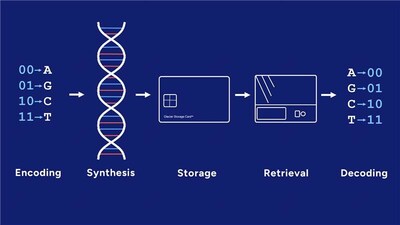
As the AI-driven surge in global data creation accelerates exponentially, existing archival storage systems built on magnetic tape and hard drives are reaching their economic and environmental limits. The strategic partnership between GenScript and Mimulus aims to address this challenge by architecting the world's first molecular archival storage that requires no electricity to preserve data once encoded into DNA and can store massive volumes of information for centuries.
Under the agreement, GenScript will industrialize high‑throughput DNA synthesis at scale, targeting a leap from millions to billions of oligonucleotides synthesized in parallel on a single chip. Building on its highly-validated manufacturing platform, currently capable of synthesizing 8 million oligonucleotides in parallel on a single chip, GenScript will deliver the scale, reproducibility, and validation required to make emerging applications like molecular data storage commercially viable. While the DNA technology landscape remains fragmented across writing, reading, and storage, GenScript brings capabilities across key parts of the DNA data storage value chain, including synthesis, sequencing-related technologies, and platform development. Combined with Mimulus' proprietary Molecular Archive Technology™, this capability enables molecular data storage to transition from laboratory innovation to commercially scalable infrastructure.
"When a new category emerges, the winners are built on infrastructure," said Sherry Shao, Rotating CEO of GenScript Biotech Corporation. "At GenScript, we believe in Scripting Possibilities - turning what was once theoretical into scalable reality. DNA-based data storage will only become a viable real-world infrastructure when synthesis can be delivered at extraordinary throughput, quality, and cost. We are building that industrial foundation to transform molecular storage from being 'scientific promise' into 'global reality'."
Mimulus Glacier Data Storage Card is replacing decaying magnetic infrastructure. By combining GenScript's proven industrial-scale synthesis engine with Mimulus's molecular transcoding architecture, this credit-card-sized device creates a completely off-stack and off-grid physical vault. The collaboration seeks to dramatically accelerate the cost curve of DNA-based storage and unlock economically viable archival systems for global cloud and AI workloads.
"Trying to solve a pressing 21st-century AI data problem with mid-century magnetic tape is a bit like trying to launch a rocket with a steam engine," said Todd R. Nelson, Ph.D., Founder and Chairman of Mimulus Corp. "But this isn't just about building a better storage device; it's about liquidating an operational liability to fuel the AI revolution. By combining our proprietary architecture with GenScript's unparalleled manufacturing scale, we are printing power permits. We are handing hyperscalers the exact megawatts they need to turn on their AI supercomputers today, unlocking a trillion-dollar flywheel that reshapes the economics of the cloud."
About GenScript Biotech Corporation
Founded in 2002 in New Jersey, GenScript Biotech Corporation accelerates innovation in biotech and healthcare by providing researchers and companies with the building blocks needed to develop ground breaking treatments and products. As a cornerstone of the global life science ecosystem, GenScript actively collaborates with a diverse network of partners—from academic institutions to industry leaders—to co-create cutting-edge solutions that redefine service excellence. Guided by its mission to Make People and Nature Healthier Through Biotechnology, GenScript has become a trusted global partner with a team of 6,100+ employees, supporting over 200,000 customers across 100+ countries and regions, including the world's Top 20 pharma companies. For more information: www.genscript.com
About Mimulus Corp
Mimulus Corp is a venture-backed biotechnology company architecting the world's first economically sustainable and physically permanent archival infrastructure for the age of AI. By combining the scaling laws of the semiconductor industry with the density of synthetic biology, Mimulus solves the global archival storage crisis and liberates critical grid power for AI compute. Led by a team of serial entrepreneurs with over $7 billion in capital formation experience, Mimulus is making the future molecular. For more information: www.mimulus.co
Media Contacts:
For GenScript: Melis Inceer, Head of Integrated Communications & Content, melis.inceer@genscript.com
For Mimulus Corp: Colette Patnaude, Founder, press@mimulus.co

Photo - https://mma.prnewswire.com/media/2952816/How_Molecular_Data_Storage_Works.jpg
Logo - https://mma.prnewswire.com/media/2952815/GenScript_Mimulus_Partner_Logo.jpg
 View original content:https://www.prnewswire.co.uk/news-releases/genscript-and-mimulus-partner-to-industrialize-dna-based-data-storage-for-the-ai-era-302737775.html

Die staatliche Autobahnholding Asfinag hat 2025 einen Überschuss von 840 Millionen Euro erwirtschaftet und damit wieder das Ergebnisniveau von 2023 erreicht. Treiber des Gewinnanstiegs waren vor allem höhere Mauteinnahmen, die im Jahresvergleich um 8,2 Prozent auf rund 2,7 Milliarden Euro zulegten. Trotz des Gewinnsprungs blieb die Verkehrsentwicklung auf Österreichs Schnellstraßen und Autobahnen weitgehend stabil: Die Gesamtfahrleistung von Pkw und Lkw erhöhte sich laut Vorstandsdirektor Herbert Kasser lediglich um 0,3 Prozent auf rund 33 Milliarden Kilometer.
Besonders kräftig wuchsen die Erlöse aus der Strecken- und Schwerverkehrsmaut. Die Einnahmen aus der Streckenmaut legten um 11,6 Prozent auf 263 Millionen Euro zu. Der Schwerverkehr brachte knapp 1,8 Milliarden Euro ein – ein Plus von 7,9 Prozent gegenüber 2024. Die klassische Autobahnvignette steuerte 655 Millionen Euro bei, 7,5 Prozent mehr als im Vorjahr. Eine wichtige Rolle spielten dabei Preisanpassungen: Die Pkw-Jahresvignette verteuerte sich 2025 um 7,7 Prozent auf 103,80 Euro. Insgesamt konnte der Überschuss damit um 14,4 Prozent gesteigert und der Ergebnisrückgang des Jahres 2024, als der Gewinn bei 734 Millionen Euro lag, wieder ausgeglichen werden.
Finanziell stärkte die Asfinag ihre Eigenkapitalbasis, während sich zugleich die Verschuldung erhöhte. Die Eigenkapitalquote stieg 2025 um einen Prozentpunkt auf 48 Prozent. Gleichzeitig wuchsen die Netto-Schulden um 180 Millionen Euro auf 10,74 Milliarden Euro. Die öffentliche Hand profitierte mehrfach: Rund 251 Millionen Euro flossen als Steuern an den Staat, nach 219 Millionen Euro im Jahr zuvor. Zusätzlich überwies die Asfinag 305 Millionen Euro als Dividende an den Bund, rund 20 Prozent mehr als 2024. Laut ÖAMTC summieren sich die Dividenden seit 2011 auf rund 2,5 Milliarden Euro; ohne diese Ausschüttungen wären die Schulden der Autobahngesellschaft nach Berechnungen des Mobilitätsclubs um etwa ein Fünftel niedriger.
Strategisch stellt die Asfinag ihr System der Mauterhebung weiter auf digital um und plant hohe Investitionen in die Infrastruktur. Ab 2027 wird es die Vignette nur noch in digitaler Form geben. Schon jetzt kann sie an rund 3.500 Vertriebspunkten sowie an 100 Automaten an 34 Standorten erworben werden; im laufenden Jahr soll das Vertriebsnetz um 10 bis 15 Automaten und etwa 1.000 zusätzliche Verkaufspunkte erweitert werden. Kundinnen und Kunden erhalten anstelle der bisherigen Klebevignette eine Bestätigung, wobei das Kfz-Kennzeichen beim Kauf registriert wird. Bis 2031 will die Asfinag insgesamt 12,5 Milliarden Euro in das heimische Autobahn- und Schnellstraßennetz investieren, rund 62 Prozent davon in Erhalt und Sanierung der bestehenden Infrastruktur.