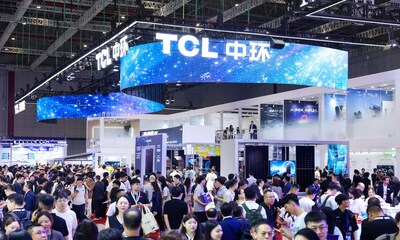
SHANGHAI, June 5, 2026 /PRNewswire/ -- Amid the PV industry's shift toward high-quality sustainable growth showcased at SNEC 2026, BC pioneer TCL Solar has transformed from a top global wafer producer into a Tier 1 module supplier.
Leading the New Era: A Dual-Engine Transformation Foundation
The PV sector enters high-quality development, prompting TCL Solar's dual layout across wafers and modules underpinned by three pillars: dominant wafer position, full industrial chain synergy and high-value product lineup.
Upstream, it consolidates silicon wafer advantages to solidify industrial fundamentals; downstream, it expands into high-efficiency modules centered on self-owned BC tech and builds a complete in-house wafer-to-module production system, capable of mass producing both BC and TOPCon products.
Silicon-Core Strength: Six Product Series Reconstructing the Value System
Wafers form TCL Solar's core business foundation. Its six customized wafer product lines set new industry benchmarks via premium quality and differentiated positioning, covering all mainstream technologies and market demands ranging from extreme performance and overseas high-end markets to cost-effectiveness and low-carbon requirements.
Guided by efficiency, intelligence and value upgrading, the firm leverages semiconductor-grade production and AI smart manufacturing to deepen cross-chain cooperation, empowering its high-reliability module development and Tier 1 development path.
Proprietary BC Leadership: Three Advantages Building a Technological Moat
Proprietary BC technology is TCL Solar's core driver for module business upgrading. As an early BC developer and mass producer, the company owns complete core patent layout across cell design, production and encapsulation.
Its BC competitiveness lies in three unique strengths: fully autonomous core IP, customized high-quality silicon wafers optimizing cell performance, and end-to-end self-controlled production enabling cost control and stable bulk delivery. Supported by these merits, the brand secures global BC leading status and paves the way for Tier 1 module supplier qualification.
Industry First: TOPCon Multi-Segment White Paper Redefines High-Efficiency Standards
Co-launched with TÜV Rheinland, TCL Solar's pioneering multi-segment module technology white paper defines new efficiency criteria. Its matching T5 PRO product obtains authoritative certification with notable power generation improvements, and the technology is poised for rapid market penetration in the coming years.
Scenario-Driven Strategy: Full Matrix Delivery for Tier 1 Strength
To qualify as a Tier 1 supplier, TCL Solar develops four core product families based on BC and TOPCon routes, covering ground power station, offshore, desert, commercial and residential scenarios with internationally recognized certification.
Value Leap: Full-Chain Strength Establishes a Tier 1 Benchmark
TCL Solar's upgrade to Tier 1 module maker results from long-term tech accumulation and full-chain integration.
Going forward, the company will keep upgrading BC and TOPCon technologies, boost industrial synergy and global layout to jointly advance low-carbon PV development alongside worldwide partners.
Photo - https://mma.prnewswire.com/media/2995598/1.jpg
 View original content:https://www.prnewswire.co.uk/news-releases/bc-driven-breakthrough-tcl-solars-value-leap-from-wafer-leadership-to-tier-1-module-supplier-302792632.html

Die Einigung zwischen den USA und dem Iran auf ein Rahmenabkommen zur Beendigung des Iran-Kriegs sorgt in der Handelsschifffahrt für vorsichtige Erleichterung. Besonders im Fokus steht die Straße von Hormus, eine der wichtigsten Seepassagen für den weltweiten Öl- und Flüssiggas-Handel. Seit Beginn des Konflikts Ende Februar ist die Meerenge weitgehend blockiert, zahlreiche Handelsschiffe sitzen im Persischen Golf fest. Nun soll die Passage nach der geplanten Unterzeichnung des Abkommens wieder geöffnet werden.
US-Präsident Donald Trump kündigte an, dass die Straße von Hormus nach dem Abschluss der Vereinbarung wieder für den Verkehr freigegeben werden solle. Die Unterzeichnung ist für Freitag in Genf vorgesehen. Für die deutsche Handelsschifffahrt wäre dies ein entscheidender Schritt zur Normalisierung. „Die Signale aus den Gesprächen zwischen den USA und dem Iran machen auch der Schifffahrt Hoffnung“, sagte Martin Kröger, Hauptgeschäftsführer des Verbands Deutscher Reeder (VDR). Zugleich mahnte er, es müsse sich erst zeigen, ob die Passage dauerhaft sicher befahrbar sein werde. Man sei „vorsichtig optimistisch“.
Die Branche hat allen Grund, auf rasche Entspannung zu hoffen. Nach Angaben des VDR sitzen aktuell noch 46 Schiffe deutscher Reedereien mit rund 1.000 Seeleuten im Persischen Golf fest. Die Blockade der Meerenge trifft nicht nur die Reedereien, sondern bremst den globalen Energiehandel. Die UN-Sonderorganisation für Seeschifffahrt (IMO) begrüßte die Einigung ausdrücklich. Seit Ausbruch des Konflikts wurden der IMO zufolge 46 Angriffe auf Handelsschiffe in der Region bestätigt, bei denen 14 Seeleute ums Leben kamen.
Trotz der diplomatischen Fortschritte sehen Branchenverbände die Lage in der Region weiter kritisch. Der internationale Schifffahrtsverband Bimco bewertet die Sicherheitslage in der Straße von Hormus auch nach Bekanntwerden des Rahmenabkommens als instabil. Eine Durchfahrt bleibe sehr riskant, heißt es aus dem Verband. Für Reeder und Charterer stellt sich damit die Frage, wie schnell und in welchem Umfang sie ihre Routen wieder über die Meerenge führen können – oder ob Ausweichrouten zumindest mittelfristig bestehen bleiben müssen.
Für den Moment überwiegt in der Schifffahrt die Hoffnung, dass die geplante Vereinbarung in Genf die Voraussetzungen für eine nachhaltige Entspannung an einem der neuralgischsten Punkte des globalen Seehandels schafft. Ob und wie schnell sich die Zahl der festliegenden Schiffe reduziert und sich die Risikoeinschätzungen der Versicherer und Verbände anpassen, dürfte entscheidend dafür sein, wann sich der Verkehr durch die Straße von Hormus wieder weitgehend normalisiert.