ASUS leverages 6th-gen AMD EPYC Server CPUs to deliver scalable, efficient compute for enterprise AI, cloud, virtualization and business-critical workloads
SAN FRANCISCO, July 24, 2026 /PRNewswire/ -- ASUS today announced its groundbreaking new server lineup powered by the AMD EPYC™ 9006 processors, engineered to deliver unmatched performance for the most demanding intensive enterprise workloads. This advanced portfolio introduces two highly optimized series with efficiency-optimized AMD EPYC SP8 server CPU, the flagship dual-socket ASUS RS700A/720A for extreme compute density and the single-socket ASUS RS500A/520A for superior space efficiency and deployment flexibility.
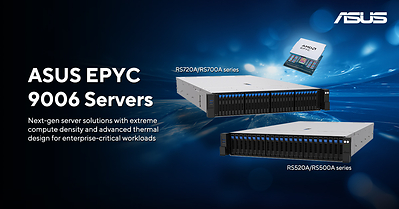
Both series integrate full PCIe® 6.0, leading memory support, and high-density E3.S storage, all underpinned by proprietary ASUS innovations for superior thermal management and operational efficiency to meet and exceed the rigorous demands of enterprise AI, virtualization, storage and cloud environments.
"The new ASUS server series, powered by 6th-gen AMD EPYC server CPUs, is engineered to power every enterprise workload with flexible, scalable infrastructure," Paul Ju, Senior Vice President of ASUS, commented, "This launch marks a significant milestone for ASUS and our clients. The new series empowers businesses with a resilient foundation to achieve unprecedented computing efficiency and accelerating AI innovation with inference."
ASUS expands 6th-gen AMD EPYC server portfolio with dual optimized series
ASUS has introduced a new server lineup segmented into two distinct series, each precisely engineered to meet diverse enterprise demands.
The flagship RS700A/720A series (dual-socket) delivers extreme compute density, making it ideal for AI inferencing, and complex simulations. It offers exceptional bandwidth with PCIe 6.0, memory leadership via 32 DIMM slots supporting ultrafast MRDIMM, and high-density storage with up to 32 E3.S bays in a compact 2U form factor.
Complementing this is the RS500A/520A series (single-socket), a highly efficient and space-optimized solution with depth under 800mm, perfect for mainstream enterprise workloads and rack-constrained environments. Featuring full PCIe 6.0 capabilities, E3.S storage support, and modular scalability through shared components with the RS700A and RS720A series, it provides uncompromised performance in a streamlined, deployment-friendly design.
ASUS elevates the AMD EPYC platform with cutting-edge proprietary innovations
ASUS has significantly advanced the AMD EPYC 9006 platform with a series of proprietary engineering breakthroughs focused on superior reliability, thermal management, and operational efficiency.
The DC-MHS modular architecture features a zone-partitioned chassis that separates I/O, HPM, fan, and storage modules to accelerate development, reduce capital costs, and enable rapid serviceability. The patented ASUS DIMM.2 Innovation repositions M.2 storage to the cooler DIMM region, eliminating thermal throttling without extra heatsinks and unlocking greater scalability. Thermal Radar 3.0 with PID Control delivers precise real-time fan regulation via advanced algorithms, reducing energy use and maintaining peak performance under heavy enterprise-level workload.
Completing the suite is the optimized tool-less operational-velocity design, which boosts maintenance efficiency, maximizing uptime and lowering TCO and sustaining peak performance even under volatile, high-load AI/HPC workloads.
AVAILABILITY & PRICING
ASUS RS700A/720A series and RS500A/520A series servers will be available soon. Please contact your local ASUS representative for further information.
 View original content to download multimedia:https://www.prnewswire.co.uk/news-releases/asus-accelerates-enterprise-ai-at-scale-with-6th-gen-amd-epyc-server-cpus-302833931.html

Bystronic hat seine Erwartungen für das laufende Geschäftsjahr 2026 nach unten angepasst. Der Hersteller von Maschinen für die Blechbearbeitung rechnet zwar weiterhin mit einem höheren Nettoumsatz als im Vorjahr, erwartet jedoch keine Verbesserung der Profitabilität mehr. Bereits im zweiten Quartal 2026 dürften Auftragseingang, Nettoumsatz und Ergebnis unter den bisherigen Annahmen liegen, obwohl sie gegenüber dem ersten Quartal zulegen sollen.
Das Management verweist auf anhaltend schwierige Marktbedingungen im Kerngeschäft. Während die Nachfrage nach Biegelösungen stabil bleibt, leidet das Lasergeschäft weiter unter einer schwachen Marktlage. Geringere Kapazitätsauslastung und Preisdruck im Verkauf von Einzelmaschinen wirken zusätzlich auf die Marge. Hinzu kommt, dass der Trend zu stärker automatisierten Lösungen zwar den Auftragsbestand stützt, die Projekte jedoch längere Laufzeiten haben und sich der hohe Auftragsbestand dadurch langsamer in Nettoumsätze umwandelt.
Einen Lichtblick liefert die neu geschaffene Geschäftseinheit Bystronic Rofin. Sie trägt nach Unternehmensangaben weiterhin positiv zum Konzernergebnis bei, gestützt von einer robusten Nachfrage nach Anwendungen im Halbleiterbereich. Dieser Bereich soll auch dazu beitragen, dass der Konzernumsatz 2026 insgesamt über dem Niveau des Vorjahres liegt, auch wenn die Ergebnisqualität im Vergleich zu 2025 zurückbleiben dürfte.
Konkrete Zahlen zu Auftragseingang, Umsatz und Ergebnis nannte Bystronic bislang nicht. Ausführlichere Informationen zur Geschäftsentwicklung und zum weiteren Ausblick will das Unternehmen mit dem Halbjahresbericht vorlegen, der am 23. Juli veröffentlicht werden soll. Dann dürfte sich zeigen, in welchem Ausmass der Druck im Lasergeschäft und die Verzögerungen bei Automationsprojekten auf die Jahresziele durchschlagen – und wie stark Bystronic Rofin diese Effekte im laufenden Jahr abfedern kann.