BEIJING, Sept. 22, 2026 /PRNewswire/ -- Tsingke today announced an integrated high-throughput validation workflow designed to help researchers experimentally evaluate large libraries of AI-designed proteins and antibodies. Combining gene synthesis, parallel expression, high-throughput screening, scale-up production, purification and quantitative binding analysis, the workflow enables researchers to move large numbers of computationally designed candidates into experimental testing and advance prioritized molecules for deeper characterization.
"AI is changing the speed at which researchers can design proteins and antibodies," said Nan Zhang, Marketing Manager at Tsingke. "The next challenge is efficiently translating computational designs into experimental data. High-throughput validation enables researchers to screen candidates at scale first, then focus resources on the molecules with greater potential for further development."
Scaling Experimental Validation for AI-Driven Protein Design
Tools such as AlphaFold, RFdiffusion and ProteinMPNN have expanded the scale and speed of protein and antibody design. Researchers can now generate large numbers of candidate sequences in a fraction of the time previously required.
As candidate pools grow from dozens to hundreds or even thousands of sequences, however, conventional one-by-one experimental workflows can become a constraint. Researchers need a way to generate experimental materials at scale, rapidly narrow candidate pools, and obtain quantitative data on prioritized molecules.
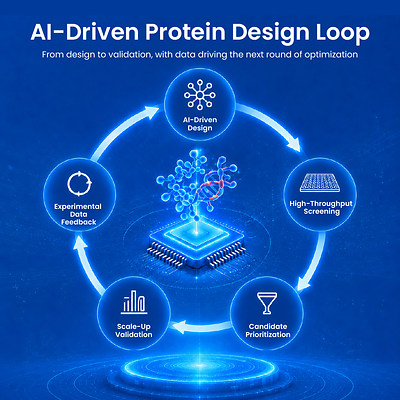
Tsingke's workflow addresses this challenge through a staged validation process.
The first stage focuses on high-throughput candidate generation and screening. Batch gene synthesis and parallel protein or antibody expression enable researchers to move large candidate sets into experimental testing. Initial screening, including ELISA-based binding assays, can then be used to identify candidates with the desired expression or binding characteristics.
The second stage focuses on prioritized candidates. Selected molecules can undergo scale-up expression, purification and gram-scale production, followed by quantitative binding analysis using technologies such as BLI or SPR. These assays can provide key kinetic parameters including KD, kon and koff, supporting more detailed candidate characterization.
This staged approach allows experimental resources to be progressively concentrated on candidates that demonstrate stronger initial performance.
Capabilities for Large-Scale Candidate Validation
This staged approach is enabled by Tsingke's capabilities across gene synthesis, protein and antibody expression, and downstream characterization.
Gene synthesis: Tsingke handles a broad range of sequence complexities and scales, including DNA fragments up to 200 kb and challenging constructs with high GC content, tandem repeats, palindromic regions, and other complex features. The GeneOptimizer algorithm enables codon optimization of candidate sequences to improve compatibility between gene design and downstream expression systems.
Protein expression: Multiple expression systems, including mammalian cell-based and cell-free platforms, are available to match different protein characteristics, expression challenges, and project stages. This flexibility allows researchers to select an appropriate expression strategy for diverse AI-designed proteins.
Antibody expression: Tsingke works with multiple antibody formats, including scFv, VHH, Fab, and full-length IgG. Its high-throughput workflow can process up to 1,500 candidates per day, with gene-to-antibody delivery in as little as 7 calendar days, plus 5 days for shipping, for applicable projects.
Supporting Experimental Validation of AI-Designed Molecules
Tsingke has supported experimental projects from clients working in AI-designed proteins and antibodies. Going forward, Tsingke will continue to enhance its technical and service capabilities, helping accelerate the transition of AI-designed molecules from computational design to experimental validation.
About Tsingke
Beijing Tsingke Biotech Co., Ltd. is a biotechnology company providing comprehensive solutions for research and therapeutic development. With expertise in molecular biology, genetics, and protein science, Tsingke offers custom DNA/RNA synthesis, gene cloning, protein expression, antibody discovery, and viral vector packaging (AAV, LV, AdV). Its ISO 13485–certified facilities and Class 100,000 cleanroom ensure consistent quality and reliability. Backed by advanced automation and a global scientific team, Tsingke accelerates innovation in drug discovery, functional genomics, and genetic engineering—empowering researchers worldwide with cutting-edge biomanufacturing solutions.
For news and updates, follow Tsingke Biotech on LinkedIn.
CONTACT: market@tsingke.com.cn
 View original content to download multimedia:https://www.prnewswire.co.uk/news-releases/tsingke-enables-high-throughput-validation-of-ai-designed-proteins-and-antibodies-302884565.html

Mit einem betont unterhaltsamen und zugleich programmatischen Auftritt hat der Kanton Schwyz seine Rolle als Gastkanton an der 83. Olma in St. Gallen übernommen. Bereits die offizielle Eröffnungsfeier im Theater St. Gallen zeigte, wie breit sich der Innerschweizer Kanton präsentieren will – kulturell, politisch und touristisch. Unter dem Motto «Schwyz liefert» rückt der Kanton während elf Tagen ein gutes Stück weiter nach Osten und nutzt die Publikumsmesse als Schaufenster für seine Produkte, sein Brauchtum und seine Eigenheiten.
Musikalisch setzte Schwyz zum Auftakt auf vertraute Namen mit regionalen Wurzeln: Unter der geistreichen, pointierten Moderation der Schwyzer Dirigentin Graziella Contratto spannten Jodlerin Nadja Räss, Schwyzerörgeler Markus Flückiger, Kontrabassist Pirmin Huber, Violinist Raphael Nussbaumer, das Ensemble Kulturschock mit Mezzosopranistin Lydia Opilik sowie Sängerin Linda Elys den Bogen von Volksmusik über Klassik bis Pop. Das Publikum im Stadttheater dankte den Schwyzer Klängen, die sonst eher zwischen Mythen und Rigi zuhause sind, mit tosendem Applaus.
Auch die Bundespolitik war prominent vertreten. Bundesrat Guy Parmelin eröffnete die Messe traditionsgemäss mit einem Ferkel – in diesem Jahr mit Säuli Vivienne, das sich beim Fototermin mit lautem Quieken gegen den Auftritt wehrte. Der Landwirtschaftsminister nutzte die Bühne, um die Olma als «herausragenden Begegnungsort» zwischen Konsumenten und Landwirtschaft zu würdigen und sprach von einer «Schweiz im Kleinformat», in der Fachleute, Familien, Politiker und Tiere zusammenkommen. Gleichzeitig verwies er auf die «Ernsthaftigkeit der Lage» für die Landwirtschaft, etwa mit Blick auf Trockenheit und grosse Hitze im vergangenen Sommer.
Der Schwyzer Landammann Sandro Patierno und Regierungsrätin Petra Steimen-Rickenbacher, Präsidentin des Organisationskomitees für den Gastkanton-Auftritt, stellten den Kanton ins Zentrum. Patierno zeigte sich besonders stolz auf den in Übergrösse ausgestellten Bundesbrief, das Hölloch und die legendären Wetterpropheten und spielte im Bühnengespräch mit Contratto mit dem Motto «Schwyz liefert». Humor bewies er auch, als er – gefragt nach seinen Lieblingstieren – Wildsäue, Wölfe und die Asiatische Hornisse nannte und festhielt, der Kanton Schwyz «liefere» auch in dieser Hinsicht. Verwaltungsratspräsident Markus Streckeisen erklärte die Olma schliesslich offiziell für eröffnet und erinnerte daran, dass die Messe aus dem Zusammenspiel vieler Menschen und Partnerschaften entstehe.
Während der elf Messetage, die in St. Gallen als «fünfte Jahreszeit» gelten, setzt der Gastkanton auf ein Konzept mit zahlreichen Boxen, in denen Besucher Produkte und Bräuche aus Schwyz entdecken können. Neben Klassikern wie der Degustationshalle bleibt auch das traditionelle Säulirennen um 16 Uhr ein Publikumsmagnet. Für Bundesrat Parmelin, der direkt von einem Staatsbesuch in Neu-Delhi an den «etwas kleineren Flughafen» Altenrhein reiste, ist der Gang durch die Olma mehr als Folklore: Er bezeichnete den offenen Dialog zwischen Produzenten, Verarbeitern, Händlern, Konsumenten und Regulierungsbehörden als zentral – eine Botschaft, die zum Selbstverständnis der Messe und zum Auftritt des Gastkantons gleichermassen passt.