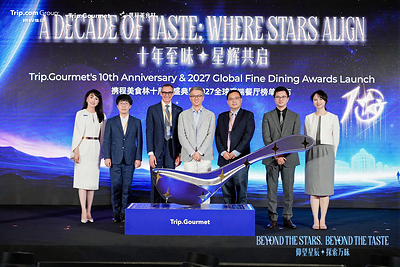
SINGAPORE, Sept. 8, 2026 /PRNewswire/ -- Trip.Gourmet, Trip.com Group's dedicated food and dining brand, today marked its tenth anniversary with the global launch of the 2027 Fine Dining List, held in partnership with Resorts World Sentosa (RWS) in Singapore. The event brought together restaurant partners, culinary experts and media from around the world to celebrate a decade of connecting travellers with the flavours that define the world's great destinations.

The 2027 Fine Dining List now spans six continents, 105 cities and 40 countries and regions, recognising 744 restaurants across three tiers - Black Diamond, the highest distinction (60), Diamond (160) and Platinum (524) - with 34 new destinations added this year across Europe, North America, Oceania, Asia, South America and Africa. Since its debut ten years ago, the list has grown from a single-market ranking into a global culinary index spanning 66 countries and regions and 462 destinations, guiding travellers toward restaurants worth building a trip around.
"Today's travellers are no longer just enjoying food at their destination - increasingly, a single meal is shaping where they choose to go, and when," said Sunny Sun, Vice President, Trip.com Group and CEO of Trip.Gourmet. "As cross-border travel becomes more frequent, our goal for the next chapter of Trip.Gourmet is simple: to help every traveller discover restaurants worth the trip, understand why they matter, and book with confidence."
From Paris to Bangkok: Fine Dining's Centre of Gravity Goes Global
This year's list reflects the breadth of global fine dining, with restaurants recognised across 40 countries and regions. Asia-Pacific anchors the list by volume, with 478 restaurants - nearly two-thirds of the global total - spread across 51 cities and 32 Black Diamond honours, led by culinary hubs including Tokyo, Shanghai and Beijing. Europe offers the broadest geographic reach of any continent, with restaurants recognised across 20 countries and regions and 35 cities, and 23 Black Diamond honours, anchored by Paris and London. The Americas contribute 63 restaurants across 14 cities, led by New York, while the list's newest frontier - spanning South Asia, the Middle East and Africa - adds 17 restaurants across 5 cities, including Dubai and Cape Town.
As host city for this year's global launch, Singapore is recognised with 27 restaurants on the 2027 Fine Dining List, spanning all three tiers: 3 Black Diamond, 8 Diamond and 16 Platinum. Singapore's Black Diamond restaurants - Odette, Les Amis and Restaurant Labyrinth - represent some of the highest culinary honours awarded anywhere in the world this year, while Diamond-tier restaurants such as Zén, JAAN by Kirk Westaway and Summer Pavilion reflect the city-state's continued rise as one of the world's most dynamic dining destinations.
"Singapore has always been a city where different cultures and flavours meet, and RWS is proud to reflect that spirit through our own dining offerings," said Chen Si, Chief Operating Officer of Resorts World Sentosa. "We are delighted to welcome Trip.Gourmet's global celebration of fine dining to RWS, and look forward to more travellers discovering the culinary experiences we have to offer."
RWS, Asia's premier lifestyle destination resort, boasts an expansive culinary landscape of more than 60 restaurants featuring diverse cuisines and celebrated chefs, with experiences ranging from fine dining to distinctive local flavours. In recent years, RWS has proactively welcomed well-known F&B brands including Peking Chamber and Chagee, further deepening its culinary offering.
The full 2027 global restaurant rankings can be viewed on the Trip.com app.
New for 2027: From List to Journey
Alongside the list, Trip.Gourmet announced two new features designed to turn culinary discovery into bookable travel experiences:
Trip.Gourmet also introduced a new China Travel Culinary List, designed to help international travellers visiting China navigate menus, dietary needs, ordering and booking. The first batch is already live across 30 cities, with coverage expected to expand to 100 cities over time.
When Dinner Decides the Destination: Food Searches Surge Worldwide
The launch comes as global interest in food-led travel continues to accelerate. According to Group data, food-related searches increased by 45% over the past eight months of 2026, with the number of distinct food-related search terms up 46% over the same period. Travellers who engaged with food-related content also showed markedly stronger engagement than the overall user base, about 41% of food-related search interactions leading users to continue exploring, compared with 28% across all search categories.
Within these searches, interest in restaurants specifically grew by 68%, buffet searches rose 66%, and café, coffee and tea searches increased 67% - pointing to travellers seeking a broader range of dining occasions during their trips. Interest in seafood rose 218%, while searches for local specialities climbed by over 700%. Increasingly, travellers are also combining destination and dining intent directly in their searches, with queries such as "Macau buffet", "Shanghai restaurant" and "Hanoi food" among the fastest-growing search patterns.
The trend is also gathering pace across new international markets. Since expanding into Europe in May 2026, food-related search has grown quickly across several European markets, led by Italy and Spain, with Germany and France - Europe's largest market by search volume - all posting strong triple digit growth. Within Asia-Pacific, destinations like Japan (+130%), Indonesia (+347%) and Hong Kong SAR (+71%) recorded the fastest-growing food-related search volumes over the same period.
About Trip.com Group
Trip.com Group is a leading global travel service provider comprising of Trip.com, Ctrip, Skyscanner, and Qunar. Across its platforms, Trip.com Group helps travellers around the world make informed and cost-effective bookings for travel products and services and enables partners to connect their offerings with users through the aggregation of comprehensive travel-related content and resources, and an advanced transaction platform consisting of apps, websites and 24/7 customer service centres. Founded in 1999 and listed on NASDAQ in 2003 and HKEX in 2021, Trip.com Group has become one of the best-known travel groups in the world, with the mission "to pursue the perfect trip for a better world". Find out more about Trip.com Group here: group.trip.com.
Follow us on: X, Facebook, LinkedIn, and YouTube.

 View original content to download multimedia:https://www.prnewswire.co.uk/news-releases/tripgourmet-unveils-global-2027-fine-dining-list-and-debuts-new-wow-privileges-programme-302872231.html

Während die Dieselpreise in Teilen Italiens neue Höchststände erreichen, zeichnet sich in Luxemburg eine spürbare Entspannung ab – und in Deutschland profitieren Autofahrer nur eingeschränkt von Steuererleichterungen. In Südtirol kletterte der Dieselhöchstpreis in Bozen Medienberichten zufolge auf 2,288 Euro pro Liter und lag damit am Mittwoch über dem Durchschnitt auf den italienischen Autobahnen. Dort wurden im Schnitt 2,287 Euro pro Liter Diesel fällig. Im gesamtstaatlichen Vergleich ist Südtirol damit weiterhin Spitzenreiter bei den Preisen.
Auch in anderen italienischen Regionen zogen die Dieselpreise deutlich an. In Trient stieg der Selbstbedienungspreis auf 2,274 Euro pro Liter, ein Anstieg um 1,1 Cent binnen eines Tages. Die stärksten Preissprünge wurden jedoch nicht in den teuersten Regionen verzeichnet, sondern im Nordosten und im Westen des Landes: In Friaul verteuerte sich ein einmaliges Volltanken von 50 Litern Diesel um 1,25 Euro, in Ligurien um 1,20 Euro, im Latium um 1,15 Euro. Auf den Autobahnen wurden Tagesanstiege von bis zu zwei Cent je Liter registriert. Der Präsident der nationalen Verbraucherunion, Massimiliano Dona, wirft der Regierung in Rom vor, zu wenig gegen die Preisanstiege zu unternehmen, und warnt vor möglichen Folgen für die Inflation.
Parallel dazu zeigt sich in Luxemburg ein gegenteiliger Trend. Dort wird Diesel nach Angaben des Wirtschaftsministeriums ab Mitternacht um 6,2 Cent je Liter günstiger und kostet dann 1,995 Euro. Damit fällt der Preis unter die Marke von zwei Euro. Die Benzinsorten Super 95 und Super 98 bleiben stabil bei 1,837 Euro beziehungsweise 2,049 Euro je Liter. Auch Heizöl wird in Luxemburg billiger: Bei Abnahme von mindestens 1.500 Litern sinkt der Literpreis am Mittwoch ebenfalls um 6,2 Cent auf 1,477 Euro. Der Großherzogtum bewegt sich damit preislich klar unter dem Niveau vieler Regionen in Italien.
In Deutschland wiederum kommt eine bereits beschlossene Steuerentlastung für Autofahrer nur begrenzt an. In Sachsen-Anhalt senkte die Bundesregierung vor rund einer Woche die Steuern auf Kraftstoffe um 17 Cent pro Liter. Laut dem Portal Benzinpreis-blitz kostete Super E10 am Mittwochnachmittag im Landesdurchschnitt 2,12 Euro pro Liter und damit lediglich rund sieben Cent weniger als am Nachmittag vor Inkrafttreten des Rabatts. Der Dieselpreis lag bei 2,19 Euro pro Liter, rund 15 Cent unter dem Vorkrisenniveau. Die Entlastung erreicht damit nicht vollständig die angekündigte Höhe, zudem spielt laut den Erhebungen die Uhrzeit eine wesentliche Rolle: Je nach Tageszeit fällt der Vorteil für Verbraucher unterschiedlich aus.
Im europäischen Vergleich entstehen damit deutliche Preisunterschiede für Dieselverbraucher. Während Italien mit Rekordständen in Teilen des Landes und spürbaren Tagesanstiegen im Fokus steht, nutzt Luxemburg den Spielraum für Preissenkungen. Deutschland versucht, über Steuersenkungen gegenzusteuern, bislang mit begrenzter Durchschlagskraft an der Zapfsäule. Für Verbraucher bleibt das Umfeld volatil – und die Frage, in welchem Umfang staatliche Eingriffe und Marktbewegungen künftig tatsächlich im Portemonnaie der Autofahrer ankommen.