After tripling its enterprise customer base, Tines rebuilt its platform for a world where every employee can build with AI.
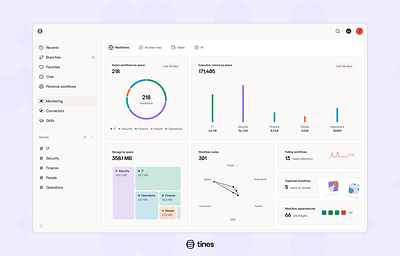
DUBLIN and BOSTON, July 28, 2026 /PRNewswire/ -- Tines, the intelligent workflow company trusted by enterprises including Coinbase, Reddit and SAP today launches Tines 3B, an AI-native platform for building, running and governing enterprise workflows, applications and agents securely at scale.
AI has made it possible for every employee to build software in minutes. The result is an explosion of vibe-coded software spread across the enterprise, much of it built outside traditional IT processes and lacking the governance, visibility and controls enterprises require.
The launch comes as the pace of building accelerates, and organizations struggle to deploy, govern and operate that software safely, and at scale. In a recent IBM study, 77% of CxOs reported that AI adoption is already outpacing current governance capabilities.
"AI has made creating software almost effortless. The hard part isn't building anymore, it's connecting that software to your systems, knowing what's running, whether you can trust it, and who's responsible for it. We saw that challenge emerging again and again with customers and started referring to it as 'Wild Code.' Once we understood the problem, it became obvious that simply bolting AI onto our existing product wasn't the answer", said Eoin Hinchy, Tines co-founder and CEO. "We built Tines 3B because we believe enterprises need an environment designed specifically to build, run and govern AI-generated workflows, applications and agents."
Tines 3B helps organizations build with AI while giving IT and Security the control to run that work safely at enterprise scale. With Tines 3B, users can:
Teams can build workflows directly in Tines 3B or any other preferred coding assistants, and use 3B to run and monitor their entire workflow environment from a single system.
Tines 3B was built by and for security and IT practitioners for environments where failure has real consequences. Every workflow step runs in a completely isolated environment, executes, and disappears. This makes cross-contamination between runs or users architecturally impossible. Sensitive data is never exposed and governance is embedded from the start.
"For years, Tines has been a trusted tool for our IT team and 3B is an exciting step forward," said Emanuele Sparvoli, Senior Director of IT at Fin, formerly known as Intercom. "It provides an environment where employees across our organization can build their own workflows, while our IT team retains the control and governance needed to enable innovation at scale.
"Like many IT teams, we think carefully about the governance challenges that come with AI — security risks, rising costs and shadow AI. 3B's governance and monitoring capabilities, including strong credential protection and access controls, were central to our decision to deploy it. We're a few weeks into our rollout and already see 3B becoming a critical part of how teams build at Fin."
Founded by Eoin Hinchy and Thomas Kinsella in Dublin in 2018, Tines was most recently valued at $1.125 billion during its Series C raise in 2025. Tines has tripled its enterprise customer base year over year, with companies including Coinbase, SAP, Experian, Reddit, Notion and Mars relying on the platform for their most critical workflows. A 124% net revenue retention rate, 302% growth in adoption of AI capabilities, and 59% weekly-to-monthly active user ratio — a benchmark more commonly associated with consumer applications than enterprise software — reflect deepening adoption across the customer base.
Tines 3B is available today while the original Tines platform, Tines Stories, continues to power mission-critical workflows for customers. For more information, visit tines.com/3b.
About Tines
Tines is the intelligent workflow company trusted by the world's most advanced enterprises. Organizations like Coinbase, Mars, Reddit, and SAP use Tines to power their most important workflows. With Tines, they've built a secure, flexible foundation to operationalize AI agents, unlocking productivity, moving faster, and future-proofing how work gets done. Co-headquartered in Dublin and Boston, Tines has raised $272M from investors including Goldman Sachs, SoftBank, Felicis, Addition, Accel, Blossom Capital, and Lux Capital.
CONTACT: tines@launchsquad.com

 View original content to download multimedia:https://www.prnewswire.co.uk/news-releases/tines-launches-3b-to-help-enterprises-govern-ai-workflows-apps-and-agents-302836524.html

In der Schweiz entscheiden die Stimmbürgerinnen und Stimmbürger am Sonntag über eine weitreichende Begrenzung der Bevölkerungszahl. Zur Abstimmung steht eine Volksinitiative der rechtskonservativen Schweizerischen Volkspartei (SVP), die den Bestand des Landes bis 2050 auf höchstens zehn Millionen Einwohner festschreiben will. Derzeit leben rund 9,1 Millionen Menschen in der Alpenrepublik, darunter etwa 340.000 Deutsche. Die Auszählung der Stimmen beginnt mittags um 12.00 Uhr, Beobachter rechnen mit einem knappen Resultat.
Die SVP, stärkste Kraft im Schweizer Parlament, vermarktet ihren Vorstoß als «Nachhaltigkeitsinitiative». Sie verspricht, mit einer Begrenzung der Zuwanderung Probleme wie Staus auf den Straßen, überfüllte Busse und Bahnen, Wohnungsknappheit, hohe Mieten und steigende Kriminalität in den Griff zu bekommen. Ab einer Schwelle von 9,5 Millionen Einwohnern müsste die Politik nach dem Willen der Initianten konkrete Maßnahmen ergreifen, etwa die Asylvergabe einschränken und den Familiennachzug begrenzen. Nach heutigen Prognosen könnte diese Marke in den 2030er-Jahren erreicht werden.
Reichen diese Einschränkungen nicht aus, sieht die Initiative als weitere Option die Kündigung der vertraglich geregelten Personenfreizügigkeit mit der Europäischen Union vor. Das Abkommen ermöglicht Bürgern aus EU-Staaten bislang einen vergleichsweise einfachen Zugang zum Schweizer Arbeitsmarkt. Eine Aufkündigung hätte nicht nur Konsequenzen für Fachkräfte aus der EU, sondern könnte auch das Verhältnis zum wichtigsten Handelspartner des Landes belasten. Für Deutsche würde ein Ja zur Initiative den Weg zum Arbeiten und Leben in der Schweiz deutlich verkomplizieren.
Bundesrat und Regierungsparteien – mit Ausnahme der SVP – lehnen die Vorlage geschlossen ab. Die Regierung warnt davor, dass ein starrer Bevölkerungsdeckel strukturelle Probleme wie Fachkräftemangel und gesellschaftliche Überalterung nicht löse. Justizminister Beat Jans bezeichnete die Initiative als «leeres Versprechen» und verwies darauf, dass sie neue Unsicherheiten schaffe, ohne die Ursachen von Engpässen auf dem Wohnungs- und Infrastrukturmarkt anzugehen. Umfragen signalisierten lange eine Mehrheit für die Vorlage, zuletzt deutete sich jedoch eine Trendwende an. Angesichts früherer Volksabstimmungen, bei denen die tatsächlichen Ergebnisse zum Teil deutlich von den Erhebungen abwichen, bleibt der Ausgang jedoch offen.