HEFEI, China, Sept. 17, 2026 /PRNewswire/ -- Sungrow, a globally leading PV inverter and energy storage system provider, recently has achieved a world first by controllably reproducing and successfully suppressing wideband oscillation at a real-world 500 MW solar-plus-storage plant in Qinghai, China. The field test marks a major step toward addressing one of the long-standing challenges facing renewable power systems as renewable penetration continues to increase worldwide.
As renewable penetration rises worldwide, wideband oscillation has become a major challenge, with severe cases potentially causing renewable plants to disconnect from the grid or shut down. In 2014, the BorWin1 offshore HVDC project in Germany experienced oscillations at 250–350 Hz, which damaged filter capacitors on the offshore converter platform and led to a shutdown lasting approximately six months, causing substantial economic losses to the local utility. In 2019, the Hornsea offshore wind farm in the UK experienced widespread disconnection due to subsynchronous oscillation, resulting in a loss of approximately 3.2% of the system load and affecting around one million users. Past incidents have demonstrated the significant impact of oscillation-related events.
However, the complex and unpredictable nature of the phenomenon has made it difficult to safely and controllably reproduce oscillations at real-world plants and validate effective suppression methods in the field. As a result, research has largely remained at the theoretical and simulation stage, with limited systematic validation in actual power plant environments.
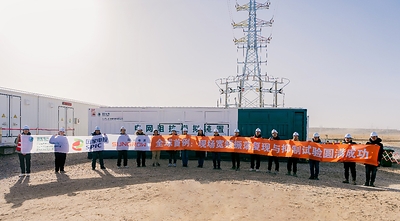
To bridge this gap, Sungrow and its industry partners conducted a field test at the plant, using Sungrow PV inverters deployed across the site.
Controlled Reproduction of Wideband Oscillation
The test established weak-grid conditions and identified three key contributing factors—power output, system short-circuit ratio (SCR), and control parameters—before successfully achieving controlled reproduction of a localized system oscillation.
Rapid Suppression of Wideband Oscillation
The field test evaluated the oscillation suppression performance of Sungrow's PV inverters under different grid conditions. Leveraging Sungrow's patented grid-strength adaptation technology, the inverters identified grid strength within 40 milliseconds, adjusted their control strategies accordingly, and rapidly stabilized voltage and frequency.
The test also validated the effectiveness of grid-forming control in suppressing wideband oscillation. Sungrow's grid-forming control strategy enables stable operation across a wide SCR range of 1~40 and effectively mitigates transient overvoltage.
By successfully reproducing and suppressing wideband oscillation at a real-world 500MW plant, the field test marks a critical step in moving wideband oscillation suppression from the laboratory into engineering practice, with the potential to improve the stability of renewable energy plants under extremely weak grid conditions, prevent grid disconnections caused by oscillations, unlock greater power export capacity for plants connected to weak grids, and reduce generation losses.
"For renewable energy to become a truly stable and reliable source of power, it is essential to develop autonomous fault self-healing and grid-support capabilities." Pan Nian'an, Chief Engineer and Chief Expert for Utility PV BU at Sungrow, said Sungrow will continue to advance research and development in grid technologies, focusing on key innovations including wideband oscillation suppression, grid-forming control, and multi-energy coordination. These efforts aim to support the stable grid integration and efficient utilization of renewable energy while strengthening the technical foundation for a secure and stable energy transition and next-generation power systems.

 View original content to download multimedia:https://www.prnewswire.co.uk/news-releases/sungrow-achieves-world-first-wideband-oscillation-reproduction-and-suppression-at-500-mw-plant-302881815.html

Beim Winterthurer Textilmaschinenhersteller Rieter kommt es zu einem abrupten Führungswechsel. CEO und Verwaltungsratspräsident Thomas Oetterli gibt beide Ämter per Ende Oktober ab. An die Spitze der Geschäftsführung rückt Anfang November der Branchenkenner Daniel Lippuner, während Carl Illi mit sofortiger Wirkung das Präsidium des Verwaltungsrats übernimmt. Rieter begründet den Schritt damit, dass nach der Umsetzung zentraler strategischer Projekte nun der Zeitpunkt gekommen sei, die Verantwortung in neue Hände zu legen.
Lippuner gilt als ausgewiesener Experte für Spinnmaschinen, Garnverarbeitung und Textilkomponenten. Er leitete früher den Textilmaschinenhersteller Saurer und zuvor den Bereich Oerlikon Textile Components. Zudem ist er Verwaltungsratspräsident und Miteigentümer von Heberlein Technology und damit weiterhin eng in der Chemiefaserindustrie verankert. Illi gehört dem Rieter-Verwaltungsrat seit 2017 an und wird vom Unternehmen ebenfalls als Textilexperte charakterisiert. Er soll das Präsidium mindestens bis zur nächsten Generalversammlung führen.
Oetterli, Jahrgang 1969 und früher Chef des Lift- und Rolltreppenherstellers Schindler, war im März 2023 zu Rieter geholt worden, um den bereits damals kriselnden Maschinenbauer zu stabilisieren. Noch im selben Jahr lancierte er das Performance-Programm «Next Level», das ein massives Kostensenkungs- und Restrukturierungspaket umfasst. Der Plan sah unter anderem vor, bis 2025 rund 1400 Vollzeitstellen vorwiegend in Deutschland, der Schweiz und weiteren europäischen Ländern abzubauen und Standorte zu konsolidieren. Parallel dazu übernahm Rieter im Februar die Textilmaschinensparte Barmag von OC Oerlikon, was mit einem deutlichen Anstieg der Verschuldung einherging.
Trotz dieser einschneidenden Massnahmen blieb die erhoffte Trendwende aus. Die Amtszeit Oetterlis war von einem ausserordentlich schwachen Marktumfeld mit anhaltender Nachfrageschwäche geprägt. 2024 hatte er zusätzlich das Präsidium des Verwaltungsrats übernommen – ein Doppelmandat, das den Aktionären ursprünglich als Übergangslösung zur konsequenten Umsetzung von «Next Level» verkauft worden war. Grösster Anteilseigner bei Rieter ist der Schweizer Industrielle Peter Spuhler mit einem Anteil von 33,1 Prozent; er sitzt ebenfalls im Verwaltungsrat. Der Führungswechsel in Winterthur folgt zeitlich auf eine ebenfalls angekündigte Neubesetzung an der Spitze von Stadler Rail, einem weiteren Unternehmen, an dem Spuhler die Kontrolle hält.