NANTONG, China, March 13, 2026 /PRNewswire/ -- Sigenergy today officially inaugurated the Sigenergy Nantong Smart Energy Center in Nantong, Jiangsu Province, China, marking a new milestone in the company's global development. The event brought together nearly 2,000 guests from more than 50 countries and regions, including founders, CEOs, and senior executives from leading distributors and installation partners worldwide, demonstrating Sigenergy's rising global influence and leadership in innovation.
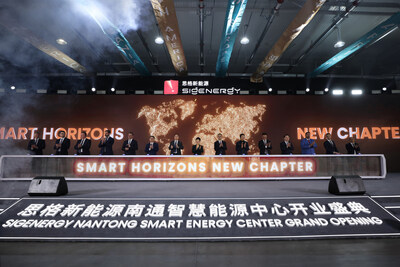
During the event, Sigenergy announced a series of landmark developments that signal the company's next phase of global growth. The company unveiled its "AI in All" strategy, and introduced new products covering residential, commercial and industrial (C&I), and utility-scale applications. Together, these milestones reinforce Sigenergy's commitment to advancing AI-driven energy innovation, intelligent manufacturing, and full-scenario energy solutions worldwide.
"AI in All": Bringing Intelligence to the Entire Energy Ecosystem
Sigenergy's "AI in All" strategy positions artificial intelligence as a core capability embedded across products, software, manufacturing, and energy management systems, transforming energy systems from simply operating to becoming intelligent, collaborative, and continuously optimized.
"Sigenergy is committed to leading the global energy transition through AI-driven innovation," said Tony Xu, Founder and CEO of Sigenergy. "Our focus is on harnessing AI to create smarter, more adaptive energy systems that set the standard for the industry."
As renewable energy and storage reshape the global energy landscape, the industry is shifting from hardware-driven competition toward integrated systems defined by user experience. Within this context, Sigenergy embeds AI as a foundational layer across its technology platform. At the product level, AI supports energy management, operational optimization, and dispatch control; through software, it enhances configuration, monitoring, and strategy execution; and at the system level, it connects distributed devices and applications, enabling coordinated and intelligent operations across residential, commercial, and utility-scale scenarios.
With the "AI in All" strategy, Sigenergy is translating AI innovation into tangible product capabilities and system intelligence, accelerating the development of smarter, more adaptive energy infrastructure worldwide.
Nantong Smart Energy Center: A New Benchmark for Intelligent Manufacturing
Supporting the global rollout of the "AI in All" strategy is the newly launched Sigenergy Nantong Smart Energy Center. Covering 136,000 square meters with an investment of RMB 500 million (≈ USD 70 million), the facility has an annual production capacity exceeding 300,000 inverters and battery packs. More than a factory, it serves as an integrated hub combining advanced R&D, intelligent manufacturing, global delivery, and energy management.
At the heart of Sigenergy's manufacturing network, the Nantong Smart Energy Center features a fully integrated digital platform that enables operators to monitor production in real time and coordinate processes across the facility. Unlike conventional factories relying on isolated automation, Manufacturing Execution Systems (MES), Warehouse Management Systems (WMS), and Energy Management Systems (EMS) are interconnected, allowing material dispatch, equipment configuration, and production adjustments to be automatically synchronized.
Sigenergy maintains industry-leading precision across key manufacturing processes. Automated welding with Charge-Coupled Device (CCD) visual inspection achieves a 99.9% yield rate, Surface-Mount Technology (SMT) lines process components at 0.043 seconds per unit with 20–30 micron accuracy, and Dual In-line Package (DIP) assembly times are cut by 50% through automation and lean practices. AI-powered quality inspections replace manual sampling, while Sigenergy's three-dimensional intelligent logistics system integrates overhead and ground material movement for optimized efficiency.
This combination of advanced equipment and intelligent systems delivers industry-leading throughput — producing one battery pack every 15 seconds and one inverter every 21 seconds. The launch of the Nantong Smart Energy Center ensures Sigenergy's original designs are realized at scale with uncompromised quality, establishing a benchmark for precision, consistency, and long-term reliability.
Expanding Full-Scenario Solutions with Three New Product Launches
Sigenergy also unveiled several new products designed to further strengthen its full-scenario energy portfolio, spanning residential, commercial & industrial, and utility-scale applications.
Through this expanded product portfolio, Sigenergy is building a comprehensive energy technology platform spanning residential systems, commercial energy infrastructure, and utility-scale power plants.
Photo - https://mma.prnewswire.com/media/2933374/20260313_165718.jpg
 View original content:https://www.prnewswire.co.uk/news-releases/sigenergy-inaugurates-nantong-smart-energy-center-pioneering-ai-in-all-strategy-and-next-gen-energy-portfolio-302713323.html


Die Julius Bär Gruppe stellt ihren Verwaltungsrat neu auf und setzt dabei klar auf zusätzliche Risiko- und Compliance-Kompetenz. Das Zürcher Vermögensverwaltungsinstitut teilte mit, dass Olga Zoutendijk an der Generalversammlung am 9. April 2026 nicht mehr zur Wiederwahl antreten wird und ihr Mandat damit niederlegt. Zoutendijk gehört dem Gremium seit sieben Jahren an und war seither Mitglied des Audit Committee sowie des Governance & Risk Committee.
Verwaltungsratspräsident Noel Quinn würdigte Zoutendijks Beitrag als «bedeutend und wertvoll» und verwies auf ihre Rolle in zahlreichen konstruktiven Debatten innerhalb der Ausschüsse. Nach einer zweijährigen Übergangsphase, in der sich die Bank laut Quinn in eine «gestärkte Position» gebracht habe, sehe Zoutendijk nun den richtigen Zeitpunkt für ihren Rücktritt gekommen. Die Personalie fällt zusammen mit der Veröffentlichung des Geschäftsberichts der Bank.
Als Ersatz schlägt Julius Bär der Generalversammlung die Wahl von Colin Bell in den Verwaltungsrat vor. Im Communiqué wird Bell als «vielseitig qualifizierte Führungspersönlichkeit aus der Bankenbranche» beschrieben. Er verfüge über umfassende Erfahrung in der Unternehmensführung und ausgewiesene Fachkenntnisse in Geldwäschereiprävention, Financial Crime Compliance und Non-Financial Risk. Die Bank hebt zudem sein technisches Know-how und seine geopolitischen Kenntnisse hervor – Letztere auch vor dem Hintergrund seiner 16-jährigen Laufbahn in Führungsfunktionen bei der britischen Armee zu Beginn seiner Karriere.
Bell hat seine operative Tätigkeit vor kurzem beendet, um sich Beratungsmandaten und Verwaltungsratsaufgaben zu widmen. Zuvor war er unter anderem Group Chief Compliance Officer bei HSBC sowie Group Chief Compliance Officer und Head Non-Financial Risk bei UBS. In diesen Funktionen baute er laut Julius Bär anspruchsvolle Compliance-Programme mit auf und pflegte enge Kontakte zu Aufsichtsbehörden wie der britischen Financial Conduct Authority, der Prudential Regulation Authority, der Europäischen Zentralbank und – in seiner Zeit bei UBS – zur Schweizer Finanzmarktaufsicht Finma. Bereits im Februar hatte Julius Bär angekündigt, der GV 2026 auch die Wahl von Urban Angehrn in den Verwaltungsrat zu empfehlen, womit das Kontrollgremium nach der Übergangsphase gezielt mit zusätzlicher Risiko- und Regulatorikexpertise verstärkt werden soll.