Average Daily Token Consumption Surpasses 300 Billion; AI-Powered Express Service Records More Than 100 Million User Interactions
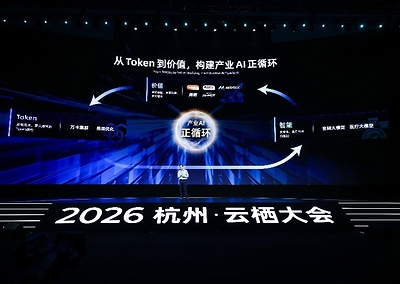
HONG KONG and SHANGHAI, Sept. 23, 2026 /PRNewswire/ -- Ping An Insurance (Group) Company of China, Ltd. ("Ping An" or the "Group"; HKEX: 2318; SSE: 601318) announced that Ping An's Chief Technology Officer, Ray Wang, was invited to speak at the 2026 Apsara Conference. In a presentation titled "From Tokens to Value: Ping An's Approach," he shared the Group's experience in deploying AI at scale across its businesses.
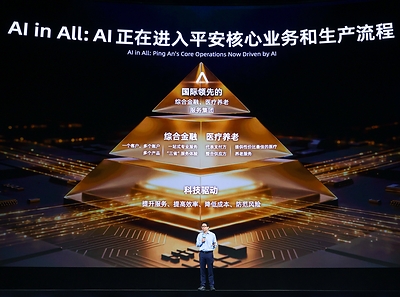
Ray said he believed that although AI capabilities continue to advance, the central question for enterprises is how to deploy AI in real-world business scenarios at a manageable cost and create measurable value. To address this challenge, Ping An has continued to advance its technology-enabled "integrated finance + health and senior care" dual-pronged strategy and "AI in ALL" approach, embedding AI across core businesses and operations. The Group has developed a practical approach that combines efficient token generation, specialized AI capabilities, and scaled deployment across real-world business use cases.
"AI is becoming embedded in Ping An's core businesses and operating processes, moving beyond providing answers to performing tasks," Ray said. "For enterprises, the key is to bring AI into real-world business applications at a manageable cost and translate its capabilities into measurable value."
AI-Powered Express Service Surpasses 100 Million User Interactions
Ping An has developed its AI-powered Express Service, enabling customers to "get things done driven by one prompt". Users can interact with the system in natural language to complete service requests. Since its launch four months ago, the platform has expanded to support more than 300 commonly used services, including transactions, financing and claims, and has recorded over 100 million user interactions.
The Express Service has achieved an end-to-end resolution rate of 92%. It has also reduced average processing time by more than 50% compared with traditional service models.
AI Doctor Provides One-Stop Support Across the Healthcare Journey
The Group continues to enhance its AI Doctor capabilities, which support the full healthcare journey, from medical consultations and multidisciplinary diagnosis and treatment to ongoing health management.
Drawing on professional medical resources from PKU Healthcare Group and working with institutions including PUMC Innovation Port, Ping An is strengthening AI capabilities for the diagnosis and treatment of specific diseases and accelerating their use in clinical practice and healthcare services. In multidisciplinary diagnosis and treatment for breast and gastric cancer, AI assessments were consistent with expert conclusions in 91% of cases. The AI hallucination rate remained below 0.3%, significantly outperforming the industry average.
AI Doctor currently serves as the first point of contact for 25% of in-hospital services. Its annual service volume is expected to exceed 100 million by the end of the year.
Average Daily Token Consumption Surpasses 300 Billion, with 2x Computing Capacity Supporting 10x Growth
As AI deployment continues to scale, Ping An has strengthened its underlying computing and model infrastructure. Over the past year, the Group's computing capacity increased from 800 PF to 1,500 PF, while average daily token consumption rose from 30 billion at the end of last year to more than 300 billion.
"By approximately doubling our computing capacity, we supported a tenfold increase in token consumption, improving efficiency while keeping costs under control," Ray said.
Through full-stack optimization spanning foundation models, inference engines, and computing resource scheduling, Ping An increased token output per unit of computing power by 368% and reduced cost per token by 76%, significantly enhancing the efficiency and economics of large-scale AI deployment.
AI Improves Productivity and Operational Efficiency, with AI-Generated Code Accounting for Approximately 80% of Total Output
Ray also shared that AI is increasingly embedded across Ping An's internal operations and business management activities.
In software development, AI-generated code accounts for approximately 80% of total code output, while around 20% of routine development tasks can now be delivered end to end by AI. In customer service, AI service representatives handled 81% of the Group's total customer service volume in the first half of the year. Quick claims accounted for 59% of life insurance claims. During the first half of the year, Ping An P&C achieved RMB7.11 billion in claims savings through AI-powered fraud detection.
Strengthening Domain-Specific Intelligence to Create Sustainable Long-Term Value
Ray indicated that while general-purpose AI is becoming increasingly capable, highly specialized sectors such as finance and healthcare require domain-specific intelligence.
To meet these demands, Ping An has built an integrated framework for domain-specific intelligence that combines proprietary data, expert-defined standards, production-grade quality controls, and feedback from real-world business scenarios. Through this approach, the Group continues to strengthen its AI capabilities and create greater value for customers, shareholders, and society.
 View original content to download multimedia:https://www.prnewswire.co.uk/news-releases/ping-an-cto-ray-wang-from-tokens-to-value-creation-302887536.html

Eine anonyme E-Mail an die US-Botschaft in Bern hat kurz vor dem Auftritt von US-Präsident Donald Trump beim Weltwirtschaftsforum in Davos ein Ermittlungsverfahren der Schweizer Bundesanwaltschaft ausgelöst – und zur Festnahme einer WEF-Mitarbeiterin geführt. Inzwischen ist klar: Die gegen die IT-Expertin erhobenen Vorwürfe eines geplanten Attentats waren nicht zu belegen. Die Bundesanwaltschaft teilte mit, die in der Sache eröffneten Ermittlungen wegen strafbarer Vorbereitungshandlungen zu einem Mord seien eingestellt worden.
Die Warnmail war laut Medienberichten der Tamedia-Gruppe wenige Stunden vor Trumps Rede eingegangen. Der anonyme Absender schilderte in fehlerhaftem Englisch eine angeblich „dringliche Bedrohung“ für das Leben des US-Präsidenten in Davos und bezeichnete die später festgenommene Frau iranischer Herkunft als Agentin, die eine entsprechende Operation koordiniert habe. Die US-Botschaft leitete den Hinweis an die Schweizer Behörden weiter; diese erklärten, sie hätten die Warnung „sehr ernst“ genommen und seien „sofort aktiv“ geworden.
Tatsächlich arbeitete die Beschuldigte nicht am Tagungsort in Davos, sondern in der WEF-Zentrale im Genfer Vorort Cologny. Dort wurde sie nach Angaben der Bundesanwaltschaft festgenommen, mehrere Stunden lang bis tief in die Nacht vernommen und ihre Telefone sowie ihr Computer wurden beschlagnahmt und ausgewertet. Im Zuge dieser Maßnahmen habe sich jedoch gezeigt, dass sich keiner der in der anonymen E-Mail erhobenen Punkte erhärten ließ. Für alle Aspekte der Anschuldigungen seien keine Beweise gefunden worden, hieß es zur Begründung für die Einstellung des Verfahrens.
Die betroffene Mitarbeiterin, eine gebürtige Iranerin, war nach den Medienberichten kurz nach dem Vorfall beim WEF nicht mehr beschäftigt. Zu den Gründen äußerte sich die Organisation nicht; auf entsprechende Anfragen gab es zunächst keine Stellungnahme. Damit bleiben nach dem spektakulären Fehlalarm vorerst Fragen offen – etwa zur Herkunft und Glaubwürdigkeit des anonymen Hinweises –, während die Schweizer Strafverfolger den Fall strafrechtlich abgeschlossen haben.