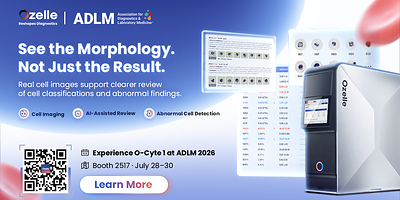
The global launch brings image-based morphology intelligence into routine hematology workflows through AI × CBM technology.
FRANKFURT, Germany and ANAHEIM, Calif., July 28, 2026 /PRNewswire/ -- Ozelle has officially launched O-Cyte 1, its newest automated hematology analyzer, at ADLM 2026 in Anaheim, California. Built on AI × CBM (Complete Blood Morphology), O-Cyte 1 marks an important step in Ozelle's vision for the 4th Generation of Hematology Analysis, combining morphology intelligence, productivity, and operational simplicity in a compact hematology system.
Modern hematology systems already provide fast, reliable, and highly automated blood cell analysis. As clinical workloads continue to grow, however, laboratories are seeking new ways to bring morphology information into routine workflows with greater consistency, visibility, and operational efficiency.
O-Cyte 1 is designed for this next stage of hematology analysis. Rather than replacing existing laboratory expertise, the system adds an image-based morphology layer to automated hematology workflows. Through AI × CBM, cell images are transformed into structured morphology insight, helping laboratories access visible cellular evidence alongside routine hematology results.
The system supports up to 60 tests per hour as a standalone unit and up to 360 tests per hour with cascaded expansion, allowing laboratories to expand capacity as workload increases. Its compact design, consumable-contained fluidics, modular architecture, and service-ready design are intended to reduce daily maintenance burden and support flexible deployment across laboratories, hospitals, health screening centers, and regional diagnostic networks.
Alongside O-Cyte 1, Ozelle also presented its expanding clinical hematology portfolio at ADLM 2026, including integrated multi-test diagnostic systems combining hematology, immunoassay, and biochemistry capabilities, as well as compact 7-Diff hematology analyzers with cell imaging and simplified maintenance. Together, the portfolio reflects Ozelle's commitment to supporting different hematology testing environments with practical, scalable, and AI-powered diagnostic solutions.
The launch of O-Cyte 1 also reflects a broader shift in Ozelle's approach to diagnostics: from standalone instruments toward integrated systems designed for real-world clinical environments. By combining advanced imaging, AI-powered interpretation, automation, and maintenance-efficient design, Ozelle aims to make morphology intelligence more accessible, consistent, and scalable across diverse clinical settings.
Following its global debut at ADLM 2026, Ozelle will continue engaging with laboratories, healthcare organizations, and strategic partners worldwide to share more about O-Cyte 1 and explore collaboration opportunities in AI-powered hematology.
To learn more or schedule a product briefing, please visit: https://forms.gle/HWkFmcpzPW2WTM7x9
Contact Ozelle
www.ozellemed.com
info@ozellepoct.com

 View original content to download multimedia:https://www.prnewswire.co.uk/news-releases/ozelle-launches-o-cyte-1-at-adlm-2026-marking-a-new-step-in-ai-powered-hematology-302834037.html

Postauto treibt den Einsatz autonomer Fahrzeuge in der Ostschweiz voran und bereitet nach eigenen Angaben Europas grösstes Robo-Taxi-Netz vor. Das Bundesamt für Strassen (Astra) hat dem Unternehmen eine Ausnahmebewilligung erteilt, damit die speziell ausgerüsteten E-Autos im St. Galler Rheintal sowie in den Kantonen Appenzell Ausserrhoden und Appenzell Innerrhoden automatisch verkehren dürfen. Seit dem 1. Juni sind die Fahrzeuge in einem rund 80 Quadratkilometer grossen Gebiet unterwegs – vorerst noch zu Testzwecken und mit Sicherheitsfahrerinnen und -fahrern an Bord.
Herzstück des Projekts ist die Flotte von bis zu 25 sogenannten "AmiGo"-Fahrzeugen, die im Endausbau mit Automatisierungsgrad Level 4 fahren sollen. Postauto kooperiert dafür mit Apollo Go, der Robotaxi-Sparte des chinesischen Technologiekonzerns Baidu. Die Fahrzeuge werden im typischen Postauto-Gelb lackiert und elektrisch betrieben. Während der Testphase dürfen die Sicherheitsfahrer ihre Hände vom Lenkrad nehmen; sie können jedoch jederzeit eingreifen, wenn die Situation es erfordert – etwa an unübersichtlichen Verzweigungen oder bei forsch auftretendem Gegenverkehr.
Im Alltagstest auf einer festgelegten Route in Altstätten (SG) zeigt sich das System laut Projektbeteiligten bereits weitgehend stabil, auch wenn der Fahrkomfort in Kurven noch nicht an einen menschlichen Chauffeur heranreicht. Auffällig ist das sehr defensive Verhalten, etwa vor Fussgängerstreifen, wo das Fahrzeug früh abbremst, selbst wenn sich Personen noch in einiger Entfernung befinden. Gesteuert wird der Betrieb zusätzlich aus einer Leitstelle, in der Operatorinnen und Operatoren die Fahrten überwachen und bei Bedarf aus der Ferne eingreifen können.
Der reguläre Betrieb mit fahrerlosen Fahrzeugen ist ab 2027 vorgesehen. Postauto plant, dass Fahrgäste in der Region ihre autonome Fahrt dann probeweise per App buchen können. Astra-Direktor Jürg Röthlisberger sieht im automatisierten Fahren eine grosse Chance und spricht dem Projekt das Potenzial eines "Gamechangers" zu. Es ist nicht der erste Versuch mit selbstfahrenden Fahrzeugen in der Schweiz, aber nach Umfang und Einsatzgebiet der bislang weitreichendste. Die Technologie soll schrittweise verfeinert und insbesondere für ländliche Regionen erprobt werden, in denen flexible, bedarfsgesteuerte Angebote die bestehende Grunderschliessung ergänzen könnten.