SINGAPORE, April 30, 2026 /PRNewswire/ -- Multi-city travel across Asia-Pacific grew 35% year-on-year this Labour Day period, according to data from Trip.com Group. Several Asia-Pacific markets including Japan, South Korea, parts of Southeast Asia and Mainland China celebrate Labour Day, driving strong cross-border and domestic travel flows across the region.

Over 30% of international trips now span multiple destinations, highlighting a continued shift towards more complex, itinerary-led travel. This shift reflects a growing preference to maximise time and value with multiple destinations within a single trip rather than a single location.

Multi-destination trips become a defining travel pattern
While single-destination travel continues to account for most bookings, growth is increasingly driven by more complex itineraries. Multi-destination bookings are growing at more than twice the pace of single-destination travel, reflecting stronger demand for flexibility and deeper exploration.
Travellers are increasingly structuring trips across multiple cities to maximise both time and value, with popular combinations including:
These itineraries reflect a growing preference for multi-stop journeys that blend urban experiences with leisure destinations.
Southeast Asia sees fast growth in multi-destination travel
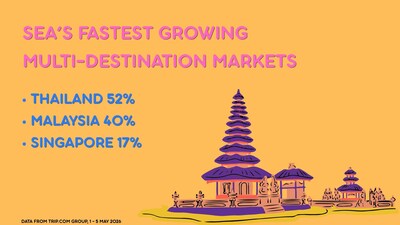
Across Southeast Asia, demand for multi-destination travel is rising steadily, with strong growth across key markets of Thailand: 52%, Malaysia: 40%, and Singapore: 17%, according to Trip.com Group data.
Top outbound destinations across Southeast Asian markets include Japan (Tokyo, Osaka), South Korea (Seoul), China (Shanghai, Beijing), Thailand (Bangkok), Indonesia (Bali).
In other parts of Asia such as Hong Kong SAR, multi-destination travel also grew by over 50% year-on-year, highlighting growing preference for more complex itineraries over traditional single-destination trips, particularly in well-connected urban markets.
In Mainland China, domestic travel remains a strong base, while overseas journeys are increasingly shaped by multi-destination itineraries, with over 40% of outbound trips spanning multiple destinations and continuing to grow.
This suggests that travellers in this region are increasingly combining multiple cities within a single trip, supported by strong regional connectivity.
Japan's domestic travel momentum on the rise
Japan is also seeing shifts in domestic travel behaviour, even as outbound demand continues to grow.
In Japan, domestic travel is growing rapidly, indicating rising interest in travelling within the country, accounting for one-quarter of all flight bookings, and to cities such as Tokyo, Sapporo and Okinawa.
Intra-Asia travel dominates Labour Day demand
The Labour Day holiday period continues to be driven by regional travel within Asia-Pacific, with travellers favouring destinations that offer ease of access, diverse experiences, and flexible itineraries.
The Group's data highlights the continued strength of short-haul travel, supported by strong connectivity and shorter flight durations.
More broadly, the way people travel across Asia-Pacific is evolving. Travellers taking a more deliberate approach to how they plan their trips. While cross-border journeys are increasingly shaped by multi-city itineraries, domestic travel remains a strong and steady part of the landscape. Together, these patterns point to a more flexible and value-conscious mindset, as travellers look to make the most of both time and budget.
About Trip.com Group
Trip.com Group is a leading global travel service provider comprising of Trip.com, Ctrip, Skyscanner, and Qunar. Across its platforms, Trip.com Group helps travellers around the world make informed and cost-effective bookings for travel products and services and enables partners to connect their offerings with users through the aggregation of comprehensive travel-related content and resources, and an advanced transaction platform consisting of apps, websites and 24/7 customer service centres. Founded in 1999 and listed on NASDAQ in 2003 and HKEX in 2021, Trip.com Group has become one of the best-known travel groups in the world, with the mission "to pursue the perfect trip for a better world". Find out more about Trip.com Group here: group.trip.com.
Follow us on: X, Facebook, LinkedIn, and YouTube.

Photo - https://mma.prnewswire.com/media/2968699/image1.jpg
Photo - https://mma.prnewswire.com/media/2968701/image2.jpg
Photo - https://mma.prnewswire.com/media/2968700/image3.jpg
Logo - https://mma.prnewswire.com/media/2919909/5944076/Trip_com_Group_Logo.jpg
 View original content:https://www.prnewswire.co.uk/news-releases/multi-destination-travel-surges-across-asia-pacific-this-labour-day-tripcom-group-data-shows-302757407.html

Die Kursaal Bern AG hat im Geschäftsjahr 2025 in einem anspruchsvollen Umfeld weniger umgesetzt und verdient, hält aber an ihrer Dividendenpolitik fest. Der Verwaltungsrat will der Generalversammlung vom 6. Juni eine unveränderte Ausschüttung von 22 Franken pro Aktie vorschlagen. Der Betriebsertrag der Gruppe aus Gastronomie, Hotellerie, Casinos und Events sank um 2,5 Prozent auf 74,7 Millionen Franken. Das EBITDA ging auf 12,4 Millionen Franken zurück, was einem Rückgang von 5,3 Prozent entspricht, das anteilige Jahresergebnis fiel um 0,5 Millionen auf 3,7 Millionen Franken.
Trotz rückläufiger Kennzahlen verweist das Unternehmen auf eine weiterhin «sehr gute» EBITDA-Marge. Diese spiegle die Effekte eines strikten Kostenmanagements und von Prozessoptimierungen wider. Die Eigenkapitalquote erhöhte sich erneut und lag Ende 2025 bei 70,3 Prozent, ein Plus von 2,5 Prozentpunkten gegenüber dem Vorjahr. Gleichzeitig wurde die Belegschaft angepasst: Die Zahl der Vollzeitstellen verringerte sich um 15 auf 382.
Operativ stand das Jahr im Zeichen besonderer Belastungen. In der Stadt Bern führte die baubedingte Sperrung der Kornhausbrücke zu geringeren Frequenzen in der Gastronomie und drückte die Umsätze in den klassischen Betrieben. Zudem schwächte sich der Markt für terrestrische Casinos ab: Das Grand Casino Kursaal Bern und das Casino Neuenburg verzeichneten einen Rückgang des Bruttospielertrags. Gegengewichte setzten die digitalen Angebote – insbesondere das Onlinecasino 7melons.ch, das ein «erfreuliches Wachstum» erzielte – sowie das Hotelgeschäft, das im Swissôtel Kursaal Bern dank steigender durchschnittlicher Zimmerpreise und der Rolle als UEFA-Host-Hotel bei der Frauenfussball-Europameisterschaft zusätzliche Aufmerksamkeit erhielt.
Strategisch treibt die Gruppe die technologische und digitale Erneuerung voran. Ende 2025 wurde die Technikpartnerschaft an die IDS Group vergeben, zu der unter anderem Kilchenmann AG und auviso AG gehören. Im neuen Modell beteiligt sich die Kursaal Bern AG an den Investitionen in Audio- und Videotechnik; daraus resultierten neu aktivierte immaterielle Vermögenswerte in Höhe von 1,6 Millionen Franken. Parallel dazu forciert das Unternehmen die Digitalisierung interner Abläufe, um Kosten zu senken und die Produktivität zu erhöhen – bei gleichzeitiger Sensibilisierung für Risiken wie Cyberangriffe, Datenverluste und Reputationsschäden.
Für das laufende Jahr zeigt sich die Kursaal Bern AG verhalten zuversichtlich. Trotz geopolitischer Unsicherheiten rechnet die Gruppe mit moderatem Wachstum und will insbesondere das Eventgeschäft mit eigenen Formaten ausbauen, etwa gemeinsam mit dem Berner Kulturlokal Bierhübeli im Kultursaal Bern. Dagegen dürfte die Hotellerie laut Unternehmensangaben unter den unsicheren globalen Rahmenbedingungen leiden, weshalb mit Belastungen in diesem Segment gerechnet wird.