CLARK, N.J., Oct. 12, 2026 /PRNewswire/ -- GEP Global Supply Chain Volatility Index — a leading indicator tracking demand conditions, shortages, transportation costs, inventories and backlogs, based on a monthly survey of 27,000 businesses — showed global manufacturers ramping up purchases of raw materials and components in September as underlying demand strengthened.
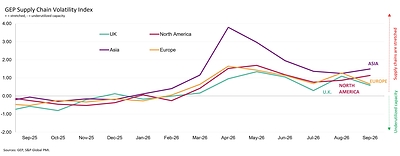
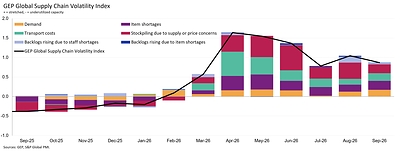
Global input demand growth rose to its strongest since May and was close to its 2026 high, signaling firmer manufacturing activity heading into the fourth quarter. Purchasing strengthened across North America, Asia and Europe, with particularly strong increases in the United States, Germany, Taiwan and South Korea.
At the same time, supply pressures intensified. Shortages increased for the first time since May, while global transportation costs also rose. Shortages of oil and oil-based products were particularly acute, creating renewed cost and availability pressures for manufacturers.
"Manufacturers are buying more because demand is strengthening, but they're doing so at a time when shortages and transportation costs are starting to rise again," said John Piatek, vice president, GEP Consulting. "For companies, that means the priority shifts from simply protecting inventory to securing supply and controlling costs. If demand continues to build through the fourth quarter, businesses that wait will face tighter availability and higher input costs."
Interpreting the data:
Index > 0, supply chain capacity is being stretched. The further above 0, the more stretched supply chains are.
Index < 0, supply chain capacity is being underutilized. The further below 0, the more underutilized supply chains are.
SEPTEMBER 2026 REGIONAL KEY FINDINGS
SEPTEMBER 2026 KEY FINDINGS
For more information, visit www.gep.com/volatility.
Note: Full historical data dating back to January 2005 is available for subscription. Please contact economics@spglobal.com.
The next release of the GEP Global Supply Chain Volatility Index will be 8 a.m. ET, Nov. 11, 2026.
About the GEP Global Supply Chain Volatility Index
The GEP Global Supply Chain Volatility Index is produced by S&P Global and GEP. It is derived from S&P Global's PMI® surveys, sent to companies in over 40 countries, totaling around 27,000 companies. The headline figure is a weighted sum of six sub-indices derived from PMI data, PMI Comments Trackers and PMI Commodity Price & Supply Indicators compiled by S&P Global.
A Supply Chain Volatility Index is also published at a regional level for Europe, Asia, North America and the U.K. For more information about the methodology, click here.
Media Contacts
Derek Creevey
Director, Public Relations
GEP
Phone: +1 646-276-4579
Email: derek.creevey@gep.com
Joe Hayes
Senior Principal Economist
S&P Global Market Intelligence
Phone: +44-1344-328-099
Email: joe.hayes@spglobal.com
 View original content to download multimedia:https://www.prnewswire.co.uk/news-releases/manufacturers-ramp-up-purchasing-in-september-as-global-demand-strengthens-gep-global-supply-chain-volatility-index-302905220.html

Beim Winterthurer Textilmaschinenhersteller Rieter kommt es zu einem abrupten Führungswechsel. CEO und Verwaltungsratspräsident Thomas Oetterli gibt beide Ämter per Ende Oktober ab. An die Spitze der Geschäftsführung rückt Anfang November der Branchenkenner Daniel Lippuner, während Carl Illi mit sofortiger Wirkung das Präsidium des Verwaltungsrats übernimmt. Rieter begründet den Schritt damit, dass nach der Umsetzung zentraler strategischer Projekte nun der Zeitpunkt gekommen sei, die Verantwortung in neue Hände zu legen.
Lippuner gilt als ausgewiesener Experte für Spinnmaschinen, Garnverarbeitung und Textilkomponenten. Er leitete früher den Textilmaschinenhersteller Saurer und zuvor den Bereich Oerlikon Textile Components. Zudem ist er Verwaltungsratspräsident und Miteigentümer von Heberlein Technology und damit weiterhin eng in der Chemiefaserindustrie verankert. Illi gehört dem Rieter-Verwaltungsrat seit 2017 an und wird vom Unternehmen ebenfalls als Textilexperte charakterisiert. Er soll das Präsidium mindestens bis zur nächsten Generalversammlung führen.
Oetterli, Jahrgang 1969 und früher Chef des Lift- und Rolltreppenherstellers Schindler, war im März 2023 zu Rieter geholt worden, um den bereits damals kriselnden Maschinenbauer zu stabilisieren. Noch im selben Jahr lancierte er das Performance-Programm «Next Level», das ein massives Kostensenkungs- und Restrukturierungspaket umfasst. Der Plan sah unter anderem vor, bis 2025 rund 1400 Vollzeitstellen vorwiegend in Deutschland, der Schweiz und weiteren europäischen Ländern abzubauen und Standorte zu konsolidieren. Parallel dazu übernahm Rieter im Februar die Textilmaschinensparte Barmag von OC Oerlikon, was mit einem deutlichen Anstieg der Verschuldung einherging.
Trotz dieser einschneidenden Massnahmen blieb die erhoffte Trendwende aus. Die Amtszeit Oetterlis war von einem ausserordentlich schwachen Marktumfeld mit anhaltender Nachfrageschwäche geprägt. 2024 hatte er zusätzlich das Präsidium des Verwaltungsrats übernommen – ein Doppelmandat, das den Aktionären ursprünglich als Übergangslösung zur konsequenten Umsetzung von «Next Level» verkauft worden war. Grösster Anteilseigner bei Rieter ist der Schweizer Industrielle Peter Spuhler mit einem Anteil von 33,1 Prozent; er sitzt ebenfalls im Verwaltungsrat. Der Führungswechsel in Winterthur folgt zeitlich auf eine ebenfalls angekündigte Neubesetzung an der Spitze von Stadler Rail, einem weiteren Unternehmen, an dem Spuhler die Kontrolle hält.