XI'AN, China, July 29, 2026 /PRNewswire/ -- LONGi is strengthening its commitment to innovation in solar mobility by supporting two of the world's leading solar racing teams at the 2026 Elektrek American Solar Challenge (ASC), one of North America's premier solar-powered endurance competitions. This year's ASC takes competitors from Minnesota to Texas, with much of the route following the historic Route 66 corridor.
Taking place from July 25 to August 1, the ASC challenges teams to cover the greatest cumulative distance over eight days, rather than compete for outright speed. As they traverse diverse climate zones and complex terrain, teams must continuously optimize energy management and strategic decision-making throughout the endurance challenge.
For LONGi, the competition serves as more than a race — it is a real-world platform for validating and advancing next-generation photovoltaic technologies.
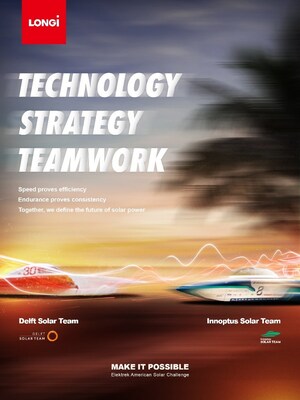
Expanding Partnerships with Two of the World's Leading Solar Racing Teams
Following its collaboration with Belgium's Innoptus Solar Team at the 2025 Bridgestone World Solar Challenge (BWSC), LONGi has further strengthened its technical collaboration within the global solar racing community.
For the 2026 season, LONGi is partnering with both Belgium's Innoptus Solar Team and the Netherlands' Delft Solar Team. Both teams ranked among the top three at the 2025 BWSC and represent the only two European teams competing in this year's Elektrek American Solar Challenge.
The expanded collaboration reflects LONGi's continued commitment to working alongside global innovators to explore the potential of photovoltaic technology through real-world engineering challenges.
High-Efficiency BC Technology at the Core
Solar racing represents one of the most challenging applications for photovoltaic technology. With extremely limited surface area available on the vehicle, every solar cell must achieve maximum conversion efficiency while maintaining reliability under dynamic operating conditions, curved vehicle surfaces, temperature variations, and long-distance endurance challenges.
To meet these requirements, LONGi provides tailored BC (Back Contact) technology solutions for both teams.
Innoptus Solar Team is equipped with LONGi's customized high-efficiency BC flexible modules, specifically designed for the curved surfaces and lightweight architecture of solar race cars. Meanwhile, Delft Solar Team integrates LONGi's high-efficiency BC solar cell strings into its vehicle's energy system.
As the vehicle's sole direct energy source, the photovoltaic system determines how effectively sunlight can be converted into usable power. High conversion efficiency, lightweight design, and operational reliability provide the foundation for innovations in aerodynamics, energy management, and vehicle control.
Technology, Strategy and Teamwork: Making Peak Performance Possible
Achieving peak performance in the Elektrek American Solar Challenge requires more than advanced photovoltaic technology alone. As the foundation of every solar race car, high-efficiency PV technology determines how much energy the vehicle can capture from sunlight and directly influences the power available throughout the journey.
Beyond the photovoltaic system, teams must continuously balance energy management, route strategy, and driving decisions based on changing sunlight conditions, weather patterns, and terrain. Every choice plays a role in maximizing the vehicle's potential and extending its range throughout the eight-day challenge.
Peak performance is also made possible through close collaboration between drivers, engineers, and technology partners. By combining technical expertise, strategic thinking, and teamwork, these collaborations transform innovative concepts into real-world performance.
Through its partnerships with leading solar racing teams, LONGi continues to explore the possibilities of high-efficiency photovoltaic technology in demanding environments, gaining valuable insights that help advance future solar applications.
Driving Innovation Beyond the Race
LONGi's partnerships with leading solar racing teams are built on technical collaboration and co-creation rather than sponsorship alone.
The company views solar motorsport as an innovation platform where advanced photovoltaic technologies can be validated, refined, and further developed under real operating conditions. technology innovation, combining expertise across industries to accelerate breakthroughs in photovoltaic performance.
The value of these partnerships extends beyond the race itself. By working together with engineers, researchers, and innovators around the world, LONGi aims not only to provide advanced solar technologies, but also to foster an open innovation ecosystem where collective insights and collaboration help expand the boundaries of what solar energy can achieve.
As the global energy system evolves toward a more sustainable and integrated future, LONGi remains committed to advancing photovoltaic innovation, strengthening collaboration across the energy ecosystem, and unlocking new possibilities for a cleaner energy transition.

Photo - https://mma.prnewswire.com/media/3008199/image1.jpg
Logo - https://mma.prnewswire.com/media/1606520/LONGi_Logo.jpg
 View original content:https://www.prnewswire.co.uk/news-releases/longi-bc-technology-powers-two-world-leading-solar-racing-teams-at-the-2026-elektrek-american-solar-challenge-302837280.html

Die Schweiz stimmt an diesem Wochenende über eine der umstrittensten Initiativen der vergangenen Jahre ab: „Keine 10-Millionen-Schweiz!“. Der Vorstoß der nationalkonservativen Schweizerischen Volkspartei (SVP), auch bekannt als Schweizerische Volkspartei oder Swiss People's Party, sieht vor, die ständige Wohnbevölkerung des Landes bis 2050 auf maximal zehn Millionen Menschen zu begrenzen. Nach ersten Hochrechnungen tendieren die Stimmbürgerinnen und Stimmbürger dazu, die Initiative abzulehnen – ein Ergebnis, das im Vorfeld keineswegs sicher schien.
Die Initiative, die in der Verfassung verankert werden soll, würde den Bund verpflichten, Gegenmaßnahmen zu ergreifen, sobald die Bevölkerung 9,5 Millionen erreicht. Die Schweiz zählte Ende 2025 bereits gut 9,1 Millionen Einwohner – rund 1,7 Millionen mehr als 2002. Haupttreiber des Wachstums ist die Zuwanderung. Rund 28% der im Land lebenden Menschen besitzen keinen Schweizer Pass. Viele stammen aus EU-Staaten wie Italien, Deutschland und Portugal, hinzu kommen Personen aus Drittstaaten, darunter Asylsuchende.
Unterstützer der Initiative argumentieren, das Land stoße an seine Belastungsgrenzen. Sie verweisen auf steigende Mieten, überlastete Verkehrswege, Staus sowie eine als problematisch wahrgenommene Entwicklung bei Gewalt und Kriminalität, die sie mit einer höheren Zuwanderung verknüpfen. Ziel sei es laut Kampagnenmotto, „zu bewahren, was wir lieben“. Die SVP wirbt mit auffälligen Aufklebern, Fahnen und Plakaten in Nationalfarben, um eine Begrenzung des Bevölkerungswachstums als Schutz der Lebensqualität zu präsentieren.
Gegen die Initiative stellen sich der Bundesrat, das Parlament, die Kantone sowie die meisten übrigen großen Parteien, gestützt von Wirtschaftsverbänden und Gewerkschaften. Sie warnen, ein starres Bevölkerungs- und damit faktisches Zuwanderungslimit könne den bereits bestehenden Arbeitskräftemangel verschärfen. Laut Bundesamt für Statistik waren im ersten Quartal 2026 rund 1,87 Millionen ausländische Erwerbstätige in der Schweiz beschäftigt. Etwa vier von fünf kamen aus EU- oder EFTA-Staaten oder dem Vereinigten Königreich, der Rest aus Drittstaaten. Viele arbeiten in Bereichen wie Gesundheitswesen, Bau und Gastgewerbe – Sektoren, die stark auf Personal aus dem Ausland angewiesen sind.
Ein weiterer Konfliktpunkt ist das Verhältnis zur Europäischen Union. Die Initiative sieht vor, dass die Schweiz in letzter Konsequenz das Abkommen über die Personenfreizügigkeit mit der EU kündigen müsste, sollte die Obergrenze sonst nicht zu halten sein. Gegner befürchten, dies könnte die bilateralen Beziehungen und den Zugang zum europäischen Arbeitsmarkt belasten. Befürworter halten dem entgegen, nur mit klaren quantitativen Vorgaben lasse sich der Druck auf Wohnungsmarkt, Infrastruktur und öffentliche Dienste nachhaltig begrenzen.
Parallel zur Abstimmung über die 10-Millionen-Grenze entscheiden die Stimmberechtigten auch über eine Verschärfung des Zivildienstgesetzes. Im Fokus der innenpolitischen Debatte steht jedoch vor allem die Frage, wie die Schweiz Wachstum, Wohlstand und gesellschaftlichen Zusammenhalt künftig austarieren will. Das Ergebnis der Volksabstimmung dürfte zwar die Initiative selbst klären, die Grundsatzdiskussion über Zuwanderung, Arbeitskräftebedarf und Lebensqualität in der Alpenrepublik jedoch kaum beenden.