Consolidation of Instrument Cluster and Infotainment System Helps Deliver a Unified In-Vehicle Experience and Optimized System Architecture
News Summary
SEOUL, South Korea, Oct. 6, 2026 /PRNewswire/ -- LG Electronics (LG), a leader in mobility innovation, will supply its integrated cockpit solution for Renault Group's New Trafic E-Tech Electric, the automaker's first mass-produced commercial vehicle built on a software-defined vehicle (SDV) architecture, which won the International Van of the Year award.
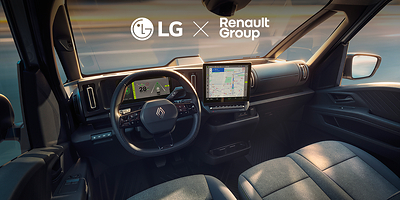
Combining the instrument cluster and infotainment system, LG's unified solution plays an integral role in the vehicle, enabling a more seamless and intuitive user experience while supporting a software-centric approach to vehicle development.
An Integrated Cockpit Solution Optimized for SDVs
LG's integrated cockpit solution is optimized for SDVs, which are rapidly becoming the new standard for the mobility sector. While conventional vehicles distribute control functions across dozens of electronic control units (ECUs) dedicated to specific areas or systems, such as the cockpit, advanced driver-assistance systems (ADAS) and powertrain, SDVs use high-performance computing and a centralized software architecture to integrate the control of multiple vehicle functions.
Another key advantage of SDVs is the ability to continuously add new features and upgrade existing ones via over-the-air (OTA) software updates.
Designed specifically for SDV environments, LG's solution integrates the control of the instrument cluster and infotainment system, serving as a key control platform for the cockpit domain. The cluster element provides driving information such as vehicle speed, revolutions per minute (RPM) and warning indicators, while the infotainment system supports features including navigation and media playback. This allows driving and infotainment information to be presented in a more consistent and intuitive way across the vehicle's displays. In addition to elevating the in-vehicle experience, LG's innovation helps automakers reduce costs through component simplification and system optimization.
Building on Proven Expertise and Strong Partnerships
LG's ability to deliver advanced solutions tailored for SDVs is rooted in its technological expertise accumulated over many years and strong industry partnerships. Drawing on its extensive experience in automotive infotainment development, software expertise and UX/UI capabilities cultivated through its mobile, TV and home appliance businesses, LG has been recognized as a trusted partner in automotive instrument clusters and infotainment systems.
LG and Renault Group have built a long-standing relationship of trust through years of close collaboration. LG was recognized by Renault Group as an outstanding supplier in 2014, 2017 and 2020, and the two companies worked together to develop an Android-based automotive infotainment system in 2021. Building on this proven collaboration, LG developed and delivered an integrated cockpit solution tailored for Renault Group's first production SDV.
Looking ahead, LG plans to further expand its partnerships with major global automakers across North America, Asia and other key markets, strengthening its position as a trusted supplier in the fast-growing SDV automotive electronics market.
"Building on our close collaboration with Renault Group and other global automakers, we will continue to advance the core technologies and solutions needed to support the mobility industry's transition to SDVs," said Eun Seok-hyun, president of the LG Vehicle Solution Company.
# # #
About LG Electronics Vehicle Solution Company
The LG Vehicle Solution Company (VS) is bringing LG's unique mobility innovations to the automotive industry. As a trusted and innovative partner, the company provides intelligent solutions including head units, displays, connectivity, ADAS vision systems, and software solutions integrating human-centered AI and automotive engineering into the modern AI/software-defined vehicle. Committed to "Driving better future mobility," the company has diversified its portfolio to further strengthen its capabilities, including automotive lighting systems, e-powertrain and cybersecurity. For more information, visit www.LG.com/global/mobility. To stay updated with the latest news, subscribe to the LG mobility newsletter, LG Loop at www.LG.com/global/mobility/newsletter and follow the LG VS Company LinkedIn channel at www.linkedin.com/company/lgvehiclesolution.
 View original content to download multimedia:https://www.prnewswire.co.uk/news-releases/lg-to-supply-integrated-cockpit-solution-for-renault-groups-first-commercial-sdv-302896833.html

Das Schweizer Studio Urban Games bringt seine erfolgreiche Verkehrssimulation in die nächste Runde: Transport Fever 3 ist ab sofort erhältlich – erstmals auch in einer Version für macOS. Spielerinnen und Spieler bauen darin über mehr als 125 Jahre Transportgeschichte hinweg ein eigenes Verkehrs- und Logistikimperium auf, von den ersten Pferdekutschen und Dampflokomotiven bis hin zu modernen Düsenjets, Supertankern, Hochgeschwindigkeitszügen und Helikoptern. Der Titel setzt damit die Tradition von Genre-Klassikern wie Transport Tycoon fort und positioniert sich erneut als Konkurrenz zu Städten-Simulationen wie Cities: Skylines, allerdings mit klarem Fokus auf Transport und industrielle Verknüpfungen.
Auf dem Mac richtet sich Transport Fever 3 klar an Besitzer aktueller Hardware. Urban Games verlangt mindestens einen M2‑Pro‑Chip, 16 Gigabyte Arbeitsspeicher, 90 Gigabyte freien Speicherplatz und macOS Sequoia 15. Empfohlen wird ein M4 Pro oder besser mit mindestens 24 Gigabyte RAM. Vertrieben wird das Spiel über Steam und GOG, die Einstiegsversion kostet ab 49,99 Euro. Ob zusätzlich eine Veröffentlichung im Mac App Store geplant ist, ist noch offen. Die Simulation bietet eine deutschsprachige Benutzeroberfläche und Vertonung; Videoeinblicke in das Spiel stellt der Entwickler auf YouTube bereit.
Inhaltlich bleibt Transport Fever 3 dem Kern des Genres treu, vertieft aber die Komplexität. Spieler verbinden Städte und Industrie-Standorte, organisieren Linien für Busse, Straßenbahnen, Lkw, Eisenbahnen, Schiffe, Flugzeuge und Helikopter und optimieren so den Transport von Personen und Gütern. Einnahmen generieren alle Transporte, doch zugleich steigen mit jedem Fahrzeug und jeder neuen Strecke die laufenden Kosten. Zusätzlich müssen mehrstufige Produktionsketten bedacht werden: Rohstoffe wie Holz gelangen zunächst ins Sägewerk, bevor sie als weiterverarbeitetes Produkt in die Städte geliefert werden. Fehler in der Planung oder ungenaue Umsetzung können dazu führen, dass sich Systeme gegenseitig blockieren – etwa bei langen Verbindungen über mehrere Kilometer oder im dicht getakteten innerstädtischen Verkehr.
Transport Fever 3 adressiert diese Komplexität mit einem stärker geführten Einstieg und Szenarien. Eine Einführung erläutert Schritt für Schritt grundlegende Mechaniken wie Straßenbau, Linienplanung und Fahrzeugkauf. Spezielle Szenarien führen anschließend in kompakter Form durch komplexere Zusammenhänge und setzen auf abgeschlossene, erzählerisch eingebettete Aufgaben – etwa wenn eine Stadt für einen Großanlass wie Mardi Gras vorbereitet oder ein Dorf bei der wirtschaftlichen Entwicklung unterstützt werden soll. Das Spiel legt dabei Wert auf Detailsteuerung bis hin zu Ampelphasen an Kreuzungen und erlaubt es, ein fein verzweigtes Netz aufzubauen, in dem erfahrene Spieler jede Linie und jeden Zug kennen. Besitzer von Transport Fever 2 erhalten beim Kauf der Standard- oder Deluxe-Edition auf derselben Plattform einen Treuerabatt von 10 Prozent – ein Angebot, das die bestehende Community in die neue Version mitnehmen soll.