BEIJING, Aug. 20, 2026 /PRNewswire/ -- Recently, JA powered Fisher & Paykel Healthcare's step toward a more ecosystem-friendly future by supplying New Zealand's largest rooftop photovoltaic (PV) power station in Auckland. The 5.3 MWp system, featuring JA's high-efficiency modules from their deep blue series, is helping transform healthcare manufacturing toward greener, lower-carbon practices.
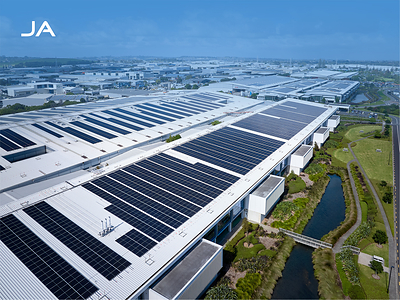
To support the Fisher & Paykel project, JA supplied and installed 8,273 modules — demonstrating its ability to deliver at scale and manage multi-party construction, both of which require precise scheduling and on-site coordination. This success was underpinned by JA's extensive experience in global projects and its warehouse network, which further ensured high-quality, on-time delivery.
In response to the global energy volatility crisis, New Zealand faced the need to increase energy independence and accelerate low-carbon transformation. As the exclusive module supplier, JA offers high-efficiency modules that are fully adaptable to challenging rooftop environments. Accordingly, these modules deliver an annual average of 6,600 MWh of power generation, reducing carbon emissions by 486 tons per year. This data suggests the modules' ability to reduce reliance on fossil fuels and set a standard for a sector-wide low-carbon transition.
Thus far, the DeepBlue series has operated with zero commissioning failures, achieving excellent power-generation efficiency and stable output. This reliability is rooted in JA's position as one of the first PV companies to enter the New Zealand market and its willingness to listen and grow in line with local demand. In support of this, research on Chinese customs export data suggests that China's PV exports to New Zealand rose to 365.5 MW at the beginning of 2025 and continued to expand to 735.5MW one year later. This suggests a growth of 101.26%, effectively doubling the market size. This surge unequivocally confirms JA's strategic market foresight and the timing of its calibrated expansion.
Sunergise is New Zealand's leading renewable energy developer and the EPC for this project; their CEO, Paul Makumbe, describes the collaboration with JA as "When you're rolling out New Zealand's largest rooftop solar, you need a partner who is reliable, who has the technical capability to deliver, has know-how and understanding of the challenges that you would face doing a project of this scale."
Rooted in the global market, JA prioritized product reliability, delivering stability and commitment to full-cycle quality. The DeepBlue series high-efficiency module has proven its value by performing in complex environments worldwide. Moving forward, JA will continue to collaborate with global partners, supporting industries across sectors to accelerate low-carbon transformation — delivering reliable power for the journey ahead —and helping the world pave the way toward a zero-carbon future.
 View original content to download multimedia:https://www.prnewswire.co.uk/news-releases/ja-powers-fisher--paykel-healthcares-green-transition-with-new-zealands-largest-rooftop-pv-system-302855929.html

Beim Winterthurer Textilmaschinenhersteller Rieter kommt es zu einem abrupten Führungswechsel. CEO und Verwaltungsratspräsident Thomas Oetterli gibt beide Ämter per Ende Oktober ab. An die Spitze der Geschäftsführung rückt Anfang November der Branchenkenner Daniel Lippuner, während Carl Illi mit sofortiger Wirkung das Präsidium des Verwaltungsrats übernimmt. Rieter begründet den Schritt damit, dass nach der Umsetzung zentraler strategischer Projekte nun der Zeitpunkt gekommen sei, die Verantwortung in neue Hände zu legen.
Lippuner gilt als ausgewiesener Experte für Spinnmaschinen, Garnverarbeitung und Textilkomponenten. Er leitete früher den Textilmaschinenhersteller Saurer und zuvor den Bereich Oerlikon Textile Components. Zudem ist er Verwaltungsratspräsident und Miteigentümer von Heberlein Technology und damit weiterhin eng in der Chemiefaserindustrie verankert. Illi gehört dem Rieter-Verwaltungsrat seit 2017 an und wird vom Unternehmen ebenfalls als Textilexperte charakterisiert. Er soll das Präsidium mindestens bis zur nächsten Generalversammlung führen.
Oetterli, Jahrgang 1969 und früher Chef des Lift- und Rolltreppenherstellers Schindler, war im März 2023 zu Rieter geholt worden, um den bereits damals kriselnden Maschinenbauer zu stabilisieren. Noch im selben Jahr lancierte er das Performance-Programm «Next Level», das ein massives Kostensenkungs- und Restrukturierungspaket umfasst. Der Plan sah unter anderem vor, bis 2025 rund 1400 Vollzeitstellen vorwiegend in Deutschland, der Schweiz und weiteren europäischen Ländern abzubauen und Standorte zu konsolidieren. Parallel dazu übernahm Rieter im Februar die Textilmaschinensparte Barmag von OC Oerlikon, was mit einem deutlichen Anstieg der Verschuldung einherging.
Trotz dieser einschneidenden Massnahmen blieb die erhoffte Trendwende aus. Die Amtszeit Oetterlis war von einem ausserordentlich schwachen Marktumfeld mit anhaltender Nachfrageschwäche geprägt. 2024 hatte er zusätzlich das Präsidium des Verwaltungsrats übernommen – ein Doppelmandat, das den Aktionären ursprünglich als Übergangslösung zur konsequenten Umsetzung von «Next Level» verkauft worden war. Grösster Anteilseigner bei Rieter ist der Schweizer Industrielle Peter Spuhler mit einem Anteil von 33,1 Prozent; er sitzt ebenfalls im Verwaltungsrat. Der Führungswechsel in Winterthur folgt zeitlich auf eine ebenfalls angekündigte Neubesetzung an der Spitze von Stadler Rail, einem weiteren Unternehmen, an dem Spuhler die Kontrolle hält.