YORKTOWN HEIGHTS, N.Y., Aug. 19, 2026 /PRNewswire/ -- IBM (NYSE: IBM) today announced it has successfully joined and cooled down two cryogenic modules into a single environment. The new architecture is designed to scale into the modular, shared, and ultra-cold system required to link hundreds of quantum chips into a more powerful quantum computer capable of solving large problems. Its deployment is a milestone on IBM's path to delivering IBM Quantum Starling in 2029, which is expected to be the world's first fault-tolerant quantum computer and will integrate advances across error correction, processor design, decoding, and systems engineering.
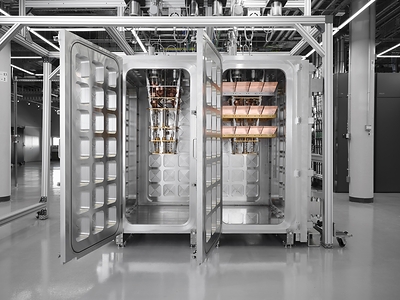
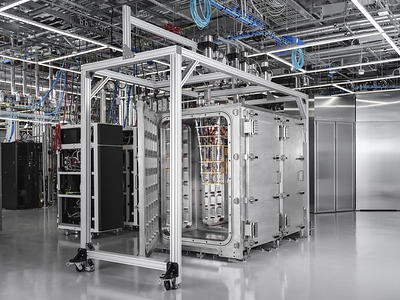
Combined, the first two operational modules stand more than 8 feet tall and 8 feet wide, and initial tests demonstrated they can jointly cool down to 4 Kelvin (the temperature of liquid helium) in under 5 days, reaching a final temperature of below 15 millikelvin shortly after. Each module's vacuum enclosure offers up to 12 times more wiring space than the most widely used IBM quantum systems, enabling more chip-to-chip connections both within and between modules.
IBM's new box-shaped design allows modules to connect in a tight row and use this larger space to directly link quantum processors with IBM's "L-coupler" technology. L-couplers connect separate quantum chips together to share information, communicate, and operate as part of a larger quantum computer.
By 2027, IBM's quantum roadmap plans to use L-couplers to link multiple processors into a larger quantum computer with at least 1,000 programmable qubits, which are qubits that can be directly used to perform computations. Towards this goal, IBM will install IBM Quantum Nighthawk processors into the cryogenic modules later this year to expand operational performance testing. At the time Starling is delivered, IBM plans for each cryogenic module to house thousands of qubits.
IBM's plans for Starling were introduced last year with a new error correction code that dramatically reduces the physical resources required for fault tolerance. Since then, the company's progression has remained on course, including the demonstration of core hardware components and breakthroughs in efficient error-correction decoding.
"Bringing fault-tolerant quantum computers to industries depends on several fundamental advances," said Jay Gambetta, Director of IBM Research and IBM Fellow. "The successful connection and operation of these cryogenic modules signals a leap forward in that direction and will accelerate our progress alongside continued innovation in quantum hardware, software, and algorithms."
IBM expects its scalable cryogenic modules to help speed its pace of innovation. For example, three essential components of IBM Quantum System Two's environment are built into the new architecture, but now in a way that allows each part to be independently tested, improved, and rapidly iterated.
The delivery of these new cryogenic quantum modules is further evidence that IBM is systematically delivering against its quantum roadmap, solving another one of the major hurdles required to accelerate its path to fault-tolerant quantum computing.
About IBM
IBM is a leading provider of global hybrid cloud and AI, and consulting expertise. We help clients in more than 175 countries capitalize on insights from their data, streamline business processes, reduce costs and gain the competitive edge in their industries. Thousands of governments and corporate entities in critical infrastructure areas such as financial services, telecommunications and healthcare rely on IBM's hybrid cloud platform and Red Hat OpenShift to affect their digital transformations quickly, efficiently and securely. IBM's breakthrough innovations in AI, quantum computing, industry-specific cloud solutions and consulting deliver open and flexible options to our clients. All of this is backed by IBM's long-standing commitment to trust, transparency, responsibility, inclusivity and service. Visit www.ibm.com for more information.
Media contacts:
Dave Mosher
IBM
dave.mosher@ibm.com
Erin Angelini
IBM
edlehr@us.ibm.com

 View original content to download multimedia:https://www.prnewswire.co.uk/news-releases/ibm-connects-its-first-modular-cryogenic-systems-in-milestone-toward-fault-tolerant-quantum-computing-302854646.html

Beim Winterthurer Textilmaschinenhersteller Rieter kommt es zu einem abrupten Führungswechsel. CEO und Verwaltungsratspräsident Thomas Oetterli gibt beide Ämter per Ende Oktober ab. An die Spitze der Geschäftsführung rückt Anfang November der Branchenkenner Daniel Lippuner, während Carl Illi mit sofortiger Wirkung das Präsidium des Verwaltungsrats übernimmt. Rieter begründet den Schritt damit, dass nach der Umsetzung zentraler strategischer Projekte nun der Zeitpunkt gekommen sei, die Verantwortung in neue Hände zu legen.
Lippuner gilt als ausgewiesener Experte für Spinnmaschinen, Garnverarbeitung und Textilkomponenten. Er leitete früher den Textilmaschinenhersteller Saurer und zuvor den Bereich Oerlikon Textile Components. Zudem ist er Verwaltungsratspräsident und Miteigentümer von Heberlein Technology und damit weiterhin eng in der Chemiefaserindustrie verankert. Illi gehört dem Rieter-Verwaltungsrat seit 2017 an und wird vom Unternehmen ebenfalls als Textilexperte charakterisiert. Er soll das Präsidium mindestens bis zur nächsten Generalversammlung führen.
Oetterli, Jahrgang 1969 und früher Chef des Lift- und Rolltreppenherstellers Schindler, war im März 2023 zu Rieter geholt worden, um den bereits damals kriselnden Maschinenbauer zu stabilisieren. Noch im selben Jahr lancierte er das Performance-Programm «Next Level», das ein massives Kostensenkungs- und Restrukturierungspaket umfasst. Der Plan sah unter anderem vor, bis 2025 rund 1400 Vollzeitstellen vorwiegend in Deutschland, der Schweiz und weiteren europäischen Ländern abzubauen und Standorte zu konsolidieren. Parallel dazu übernahm Rieter im Februar die Textilmaschinensparte Barmag von OC Oerlikon, was mit einem deutlichen Anstieg der Verschuldung einherging.
Trotz dieser einschneidenden Massnahmen blieb die erhoffte Trendwende aus. Die Amtszeit Oetterlis war von einem ausserordentlich schwachen Marktumfeld mit anhaltender Nachfrageschwäche geprägt. 2024 hatte er zusätzlich das Präsidium des Verwaltungsrats übernommen – ein Doppelmandat, das den Aktionären ursprünglich als Übergangslösung zur konsequenten Umsetzung von «Next Level» verkauft worden war. Grösster Anteilseigner bei Rieter ist der Schweizer Industrielle Peter Spuhler mit einem Anteil von 33,1 Prozent; er sitzt ebenfalls im Verwaltungsrat. Der Führungswechsel in Winterthur folgt zeitlich auf eine ebenfalls angekündigte Neubesetzung an der Spitze von Stadler Rail, einem weiteren Unternehmen, an dem Spuhler die Kontrolle hält.