BEIJING and SEOUL, South Korea, April 10, 2026 /PRNewswire/ -- Hyundai Motor Company officially launched its all-electric IONIQ lineup brand in China, unveiling two design concept cars at the IONIQ brand launch event in Beijing ahead of Auto China 2026 ('Beijing Auto Show') on April 24.
Alongside the concepts, Hyundai Motor presented a strategy aimed at strengthening its position in the Chinese market, expanding the IONIQ brand's lineup beyond products into a mobility experience.
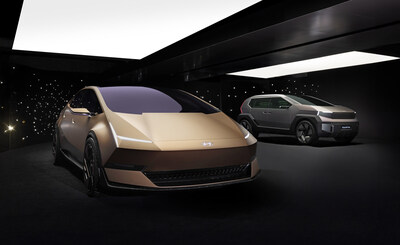
The two all-electric concept cars developed for China — the VENUS Concept, a trend-setting sedan, and the EARTH Concept, a dependable family SUV — signal the beginning of this new chapter. Both concepts highlight Hyundai Motor's readiness for China's new energy vehicle (NEV) market.
"Starting with the two concept cars unveiled today, we will continue to present products that reflect deep insight into Chinese customers and our genuine commitment to this market. Built on IONIQ's uncompromising principles of world-class safety and quality, we will soon introduce production models that seamlessly combine the smart driving and smart cabin experiences that Chinese consumers demand." – Li Fenggang, President at Beijing Hyundai Motor Company
What Is IONIQ and How Will the lineup Brand Be Tailored for China?
As Hyundai Motor's dedicated all-electric vehicle lineup brand, IONIQ has quickly become a global benchmark for innovation, design and quality. Built on critically acclaimed models such as the IONIQ 5, IONIQ 6 and IONIQ 9, the EV lineup reflects Hyundai Motor's advanced electrification capabilities and human-centric mobility vision.
IONIQ's global excellence is further underscored by multiple industry recognitions, including 'hat-trick' victories for the IONIQ 5 and IONIQ 6 at the World Car Awards. High-performance models such as the IONIQ 5 N and IONIQ 6 N have also reinforced the brand's leadership in electric performance, with IONIQ 6 N most recently named 2026 World Performance Car.
In China, IONIQ will evolve beyond a product lineup into a broader mobility ecosystem tailored to local customers. While maintaining Hyundai Motor's globally proven standards in safety and quality, IONIQ is being redefined through localized technologies, services and user experiences for China's fast-evolving NEV market.
As part of this strategy, Hyundai Motor is introducing a unique naming convention tailored for China. Future IONIQ models will be named after 'planets', symbolizing how each vehicle orbits around the customer — the central focus of this new IONIQ universe.
What Are the Two IONIQ Concept Cars for the Chinese Market?
The VENUS and EARTH concepts are the first tangible results of Hyundai Motor's new China strategy, serving as a design 'barometer' for future IONIQ production models. Guided by the ethos 'Lead, don't follow', the two concepts feature unique single-curve silhouettes that are instantly recognizable and emotionally distinctive, delivering a lasting and impactful first impression.
VENUS (Iconic Sedan): Inspired by the brightest planet's timeless beauty, VENUS presents a new icon for sedans.
EARTH (Powerful SUV): Embodying the vitality and biological balance of our home planet, EARTH is a bold and powerful family SUV.
"We chose to be 'The Origin'. Something entirely new — recognizable at a glance from a distance, with a powerful presence on the road, and delivering what we call a 'Best in First Impression'. 'The Origin' is our declaration: 'Lead, don't follow'. It is the point from which our movement begins. Our ambition is to set a new direction." – Simon Loasby, Senior Vice President and Head of Hyundai Design Center at Hyundai Motor Company
How Is Hyundai Motor Redefining Its Approach to the Chinese Market?
At the event, Hyundai Motor also provided a glimpse into exclusive IONIQ technologies tailored for Chinese customers. Key advancements include the introduction of autonomous driving systems developed with local partners and the adoption of market-specific solutions, such as extended range electric vehicles (EREVs). These technologies reflect Hyundai Motor's commitment to returning to the market with a truly human-centric philosophy, prioritizing tangible benefits that address the real-world needs of Chinese consumers.
To support this vision, Hyundai Motor has also released an IONIQ brand launch film under the message "Open Your Universe," further illustrating the brand's direction.
Further details will be unveiled during Hyundai Motor's press conference at Auto China 2026 on April 24, at Hall E4 of the China International Exhibition Center (Shunyi Hall) in Beijing.
More information about Hyundai Motor and its products can be found at https://www.hyundai.com/worldwide/en/
Photo - https://mma.prnewswire.com/media/2952988/Photo_1__Hyundai_Motor_Teases_Official_Launch_of_IONIQ_Brand_in_China.jpg
PDF - https://mma.prnewswire.com/media/2952989/Press_Release__Hyundai_Motor_Teases_Official_Launch_of_IONIQ_Brand_in_China.pdf
 View original content to download multimedia:https://www.prnewswire.co.uk/news-releases/hyundai-motor-company-launches-ioniq-lineup-brand-in-china-with-the-premiere-of-two-new-concept-cars-302738016.html

Im Gotthardmassiv im Tessin ist einem internationalen Forschungsteam erstmals gelungen, die Erde kontrolliert zum Beben zu bringen. Im Untergrundlabor "Bedrettolab", das in einem ehemaligen Baustollen des Furkatunnels eingerichtet wurde, lösten Wissenschaftlerinnen und Wissenschaftler gezielt eine Serie von Mikrobeben aus. Die beteiligte Rheinisch-Westfälische Technische Hochschule Aachen (RWTH Aachen) sprach von einem "sehr erfolgreichen" Versuch.
Über mehrere Tage injizierten Fachleute der ETH Zürich, der RWTH Aachen und des italienischen Nationalen Instituts für Geophysik und Vulkanologie (INGV) Wasser mit hohem Druck in eine natürliche Bruchzone tief im Fels. Ziel des Experiments war es, Spannungsänderungen im Gestein hervorzurufen und damit kleinste Erschütterungen auszulösen. Genau das trat ein: Registriert wurde eine ganze Serie von Mikrobeben, teilweise mit Magnituden knapp unterhalb von 0. An der Erdoberfläche waren diese Ereignisse nicht zu spüren.
Um die künstlich erzeugten Beben detailliert zu erfassen, installierte das Team Hunderte hochsensibler Sensoren in unmittelbarer Nähe der Verwerfung. Die Messinstrumente reagierten so feinfühlig, dass im Bedrettolab sogar das Erdbeben in Japan vom 20. April präzise aufgezeichnet werden konnte. Durch die direkte Platzierung an der Bruchzone konnte die Entstehung der Erschütterungen erstmals am Ursprungsort und nicht wie sonst üblich an der Erdoberfläche verfolgt werden. Die aufgezeichneten Signale seien "unglaublich", sagte Projektleiter Florian Amann von der RWTH Aachen, man erhalte einen einzigartigen Einblick in die Erdbebenphysik.
Das Experiment ist Teil des Projekts "FEAR" – kurz für "Fault Activation and Earthquake Rupture". Langfristig sollen die Daten dazu beitragen, die Vorhersagbarkeit von Erdbeben zu verbessern. Im Fokus steht die Frage, was im Gestein passiert, bevor ein größeres Beben einsetzt. Nach Angaben der Forschenden gehen starken Erdbeben typischerweise tausende kleine Ereignisse voraus. Deren Entwicklung im Labor nachzuzeichnen, soll helfen, die physikalischen Prozesse entlang natürlicher Störungszonen besser zu verstehen und Frühindikatoren für künftige Beben zu identifizieren.