SEOUL, South Korea, Oct. 6, 2026 /PRNewswire/ -- HD Hyundai has delivered the world's first "Lashing-Free" container ship, introducing a new concept that eliminates the need for workers to manually secure containers on board.
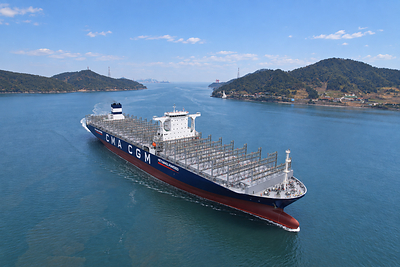
HD Hyundai announced on Tuesday, October 6, that it recently delivered a 13,000-TEU container ship for a French shipping company, with its hybrid-type Lashing-Free technology partially applied.
HD Hyundai Heavy Industries independently developed and validated all key components of the Lashing-Free technology, while HD Hyundai Samho was responsible for the detailed design and construction of the vessel incorporating the system.
The Lashing-Free container ship removes the need for manual container lashing, which has traditionally been carried out by workers using lashing equipment on large container vessels. It also incorporates technologies designed to prevent cargo loss and maximize logistics efficiency.
The vessel extends the cell guides, which support containers stacked vertically in alignment inside the cargo hold, all the way above deck.
With conventional large hatch covers, however, the extended cell guides would be obstructed, preventing them from reaching above deck. To overcome this structural limitation, HD Hyundai Heavy Industries developed a standardized portable bench that can be installed between the cell guides.
The portable bench is built to the same dimensions as a 40-foot container, allowing it to be handled using the same port cranes used to load and unload containers. The technology is expected to play a key role in accelerating automation and unmanned operations across the broader logistics network connecting land and sea, including container terminals.
HD Hyundai Heavy Industries has also developed a Twistlock Rooting System, which securely fastens containers stowed outside the cell guide area to the vessel's structure.
As a result, the Lashing-Free container ship can carry over 10% additional cargo weight on deck compared with conventional vessels of the same type. The system also provides stable support for containers even in rough seas and strong winds, helping prevent cargo loss, enhance maritime safety and reduce the risk of marine pollution.
Sea trials conducted by HD Hyundai in September showed that the Lashing-Free system significantly reduces vibration during operation compared with conventional designs using hatch covers and lashing bridges. The company is also developing a next-generation version of the technology incorporating weathertight features.
"We plan to expand the application of this new container transportation technology to small- and medium-sized vessels," said Hongryeul Ryu, Senior Executive Vice President and Chief Technology Officer at HD Hyundai Heavy Industries. "By continuing to develop differentiated technologies that deliver tangible value to customers in areas such as safety, loading efficiency and automation, we aim to further strengthen our ability to secure new orders."
Meanwhile, HD Hyundai Heavy Industries' Lashing-Free technology was introduced as a representative Korean technology related to "measures to prevent the loss of containers at sea" at the 10th session of the International Maritime Organization's Sub-Committee on Carriage of Cargoes and Containers (CCC) in 2024. The technology has secured multiple intellectual property registrations in Korea and overseas and was also selected as a recipient of this year's IR52 Jang Young-shil Award.

 View original content to download multimedia:https://www.prnewswire.co.uk/news-releases/hd-hyundai-delivers-worlds-first-lashing-free-container-ship-302899537.html

Während die Dieselpreise in Teilen Italiens neue Höchststände erreichen, zeichnet sich in Luxemburg eine spürbare Entspannung ab – und in Deutschland profitieren Autofahrer nur eingeschränkt von Steuererleichterungen. In Südtirol kletterte der Dieselhöchstpreis in Bozen Medienberichten zufolge auf 2,288 Euro pro Liter und lag damit am Mittwoch über dem Durchschnitt auf den italienischen Autobahnen. Dort wurden im Schnitt 2,287 Euro pro Liter Diesel fällig. Im gesamtstaatlichen Vergleich ist Südtirol damit weiterhin Spitzenreiter bei den Preisen.
Auch in anderen italienischen Regionen zogen die Dieselpreise deutlich an. In Trient stieg der Selbstbedienungspreis auf 2,274 Euro pro Liter, ein Anstieg um 1,1 Cent binnen eines Tages. Die stärksten Preissprünge wurden jedoch nicht in den teuersten Regionen verzeichnet, sondern im Nordosten und im Westen des Landes: In Friaul verteuerte sich ein einmaliges Volltanken von 50 Litern Diesel um 1,25 Euro, in Ligurien um 1,20 Euro, im Latium um 1,15 Euro. Auf den Autobahnen wurden Tagesanstiege von bis zu zwei Cent je Liter registriert. Der Präsident der nationalen Verbraucherunion, Massimiliano Dona, wirft der Regierung in Rom vor, zu wenig gegen die Preisanstiege zu unternehmen, und warnt vor möglichen Folgen für die Inflation.
Parallel dazu zeigt sich in Luxemburg ein gegenteiliger Trend. Dort wird Diesel nach Angaben des Wirtschaftsministeriums ab Mitternacht um 6,2 Cent je Liter günstiger und kostet dann 1,995 Euro. Damit fällt der Preis unter die Marke von zwei Euro. Die Benzinsorten Super 95 und Super 98 bleiben stabil bei 1,837 Euro beziehungsweise 2,049 Euro je Liter. Auch Heizöl wird in Luxemburg billiger: Bei Abnahme von mindestens 1.500 Litern sinkt der Literpreis am Mittwoch ebenfalls um 6,2 Cent auf 1,477 Euro. Der Großherzogtum bewegt sich damit preislich klar unter dem Niveau vieler Regionen in Italien.
In Deutschland wiederum kommt eine bereits beschlossene Steuerentlastung für Autofahrer nur begrenzt an. In Sachsen-Anhalt senkte die Bundesregierung vor rund einer Woche die Steuern auf Kraftstoffe um 17 Cent pro Liter. Laut dem Portal Benzinpreis-blitz kostete Super E10 am Mittwochnachmittag im Landesdurchschnitt 2,12 Euro pro Liter und damit lediglich rund sieben Cent weniger als am Nachmittag vor Inkrafttreten des Rabatts. Der Dieselpreis lag bei 2,19 Euro pro Liter, rund 15 Cent unter dem Vorkrisenniveau. Die Entlastung erreicht damit nicht vollständig die angekündigte Höhe, zudem spielt laut den Erhebungen die Uhrzeit eine wesentliche Rolle: Je nach Tageszeit fällt der Vorteil für Verbraucher unterschiedlich aus.
Im europäischen Vergleich entstehen damit deutliche Preisunterschiede für Dieselverbraucher. Während Italien mit Rekordständen in Teilen des Landes und spürbaren Tagesanstiegen im Fokus steht, nutzt Luxemburg den Spielraum für Preissenkungen. Deutschland versucht, über Steuersenkungen gegenzusteuern, bislang mit begrenzter Durchschlagskraft an der Zapfsäule. Für Verbraucher bleibt das Umfeld volatil – und die Frage, in welchem Umfang staatliche Eingriffe und Marktbewegungen künftig tatsächlich im Portemonnaie der Autofahrer ankommen.