- Tops in benchmark test, including reading order, tables, and title inference.
- Offers a perfect local security environment with the hybrid engine that combines AI and direct extraction heuristic engine
- Four AI functions via free AI add-ons; OCR, Table AI, Chart and Formula AI
- Change to Apache-2.0 licensing from MPL-2.0
SEOUL, South Korea, March 13, 2026 /PRNewswire/ -- Hancom, the South Korean software company behind the widely used Hangul word processor, has released OpenDataLoader PDF v2.0 — and the benchmark numbers back up the claim. In the company's own internal testing, OpenDataLoader PDF outperformed competing open-source tools across reading order recognition, table extraction, and heading inference. Hancom has published the full benchmark dataset and reproducible code on its official GitHub repository, allowing developers to verify the results independently.
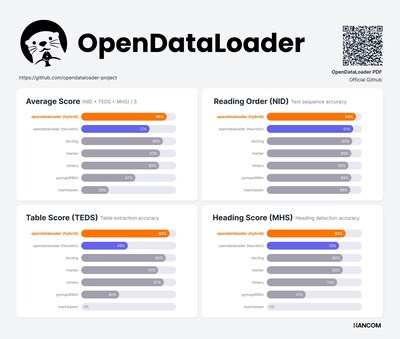
The headline engineering move is a hybrid extraction engine that pairs AI-based parsing with direct extraction. The practical upside: enterprises and developers get high-accuracy PDF data extraction that runs entirely on-premise, with no data leaving the local environment. For organizations handling sensitive documents — legal, financial, medical — that's not a minor footnote.
Four Free AI Add-ons, Out of the Box
OpenDataLoader PDF PDF v2.0 includes the following four AI features as add-ons at no additional cost:
All four are built for compatibility with third-party open-source models, including Docling. Hancom is clear that no formal partnership or sponsorship is in place — the compatibility is purely technical, designed so developers can slot OpenDataLoader PDF into existing pipelines without rebuilding their stack.
Apache 2.0: Lowering the Barrier, Expanding the Ecosystem
The project has also shed its MPL 2.0 license in favor of Apache 2.0 — one of the most permissive open-source licenses available. The move directly reduces friction for commercial use, making it easier for global developers and enterprises to build on top of OpenDataLoader PDF without navigating license compatibility headaches. Hancom expects this to accelerate downstream business models including WebApp and SaaS applications built on the engine.
Ecosystem Expansion: LangChain Is In, More Integrations Coming
LangChain integration shipped in 2025. In 2026, Hancom is targeting Langflow, LlamaIndex, and Gemini CLI, plus MCP (Model Context Protocol) support for agentic AI workflows. The roadmap positions OpenDataLoader PDF as infrastructure for the autonomous AI agent era, not just a standalone parsing tool.
Later in 2026, a commercial AI add-on is planned — described as a concentration of Hancom's proprietary document AI technology.
AI based auto-tagging to Tagged PDF: Start The Accessibility Play
Perhaps the most forward-looking item on the roadmap is PDF accessibility. With the European Accessibility Act (EAA) now in force, South Korea's anti-discrimination legislation tightening, and accessibility regulations expanding globally, compliance has become a real operational burden for enterprises. Hancom says OpenDataLoader PDF will be the first open-source PDF tool to include AI-generated accessibility tagging — This will be the first open-source solution to provide a key step toward PDF/UA compliance.
What Hancom's CTO Said
"OpenDataLoader PDF v2.0 has evolved into an open PDF data platform that anyone can freely use and build upon, through its AI hybrid engine and transition to Apache 2.0," said Jihwan Jeong, CTO of Hancom. "With upcoming commercial AI add-ons and accessibility solutions, we aim to lead the global ecosystem — making PDF documents not only AI-ready, but accessible to everyone."
OpenDataLoader PDF PDF v2.0 is available now. Source code, benchmark datasets, and documentation are published at the OpenDataLoader PDF official GitHub repository.
Photo - https://mma.prnewswire.com/media/2933181/opendataloader_benchmark.jpg
 View original content:https://www.prnewswire.co.uk/news-releases/hancom-tops-open-source-pdf-benchmarks-with-opendataloader-pdf-v2-0--302713099.html

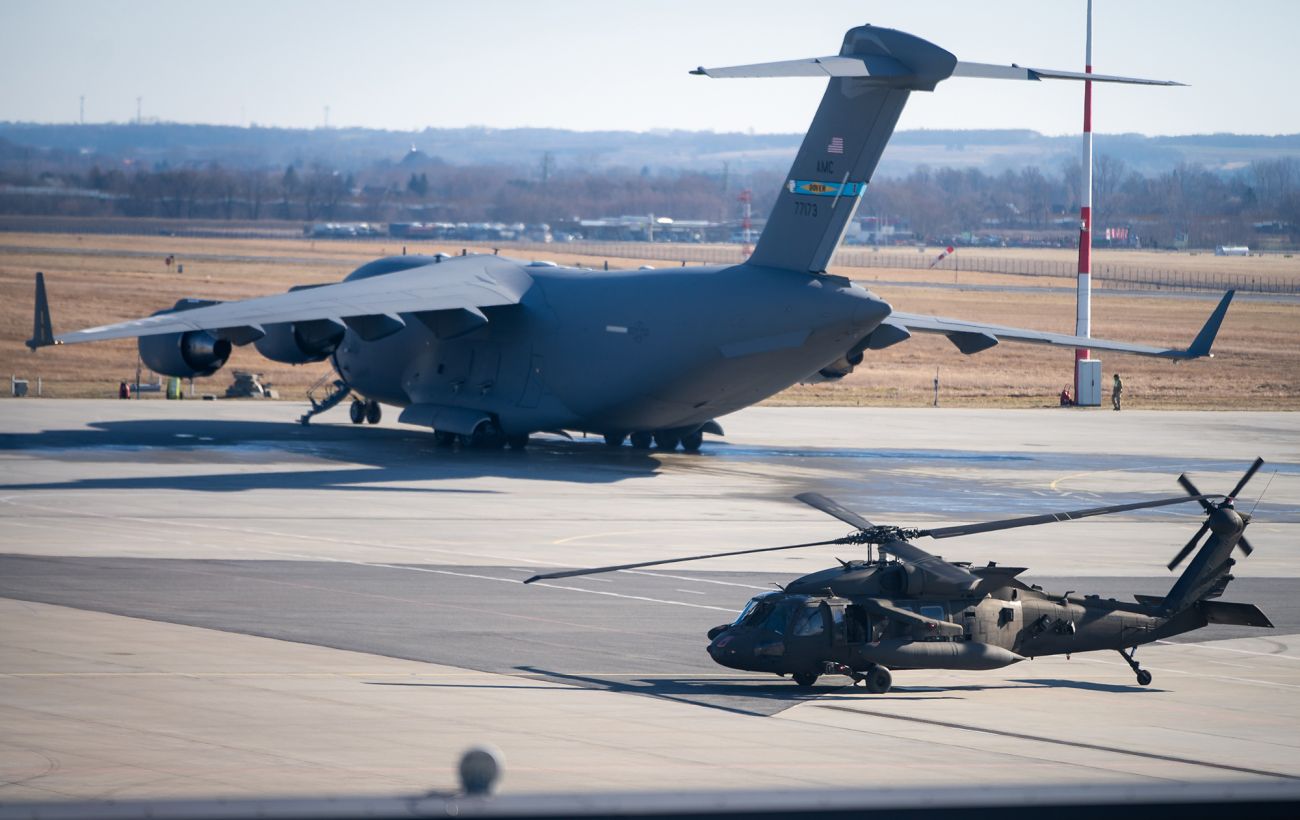
Die Schweiz hat Überflugrechte für mehrere US-Militärmaschinen im Zusammenhang mit den jüngsten Angriffen auf den Iran nur teilweise gewährt und dabei ihre Neutralität demonstrativ betont. Der Bundesrat lehnte zwei Gesuche für Aufklärungsflüge ab, während er einen Wartungsflug sowie zwei Transportflüge billigte. Nach Angaben der Regierung in Bern verstieß die beantragte Nutzung des Schweizer Luftraums durch US-Aufklärungsflugzeuge gegen die Vorgaben des Neutralitätsrechts, wonach militärisch relevante Flüge von Konfliktparteien über das Territorium eines neutralen Staates untersagt sind.
Hintergrund sind seit Ende Februar zunehmende Spannungen im Nahen Osten, seit die USA und Israel den Iran ins Visier genommen haben. Seither gehen beim Bundesamt für Zivilluftfahrt (BAZL) vermehrt Anfragen für Überflüge von US-Staats- und Militärmaschinen ein. Die Behörde prüft diese in Abstimmung mit dem Aussendepartement, dem Verteidigungsministerium sowie dem Wirtschaftsdepartement auf Basis der luftrechtlichen Souveränitätsregeln. In politisch heiklen Fällen entscheidet der Bundesrat selbst. Humanitäre und medizinische Flüge, etwa zur Evakuierung von Verwundeten, sowie klar konfliktunabhängige Missionen bleiben nach Regierungsangaben grundsätzlich zulässig.
Das BAZL bestätigte, dass zwei US-Gesuche seit Beginn der jüngsten Eskalation aus verfahrenstechnischen Gründen nicht bewilligt wurden, weil die notwendigen Abklärungen nicht rechtzeitig abgeschlossen werden konnten. Parallel dazu befasst sich die Landesregierung mit der Frage, ob die militärischen Auseinandersetzungen zwischen den USA, Israel und dem Iran neutralitätsrechtlich bereits als Krieg einzustufen sind. Dafür müssten bewaffnete Konflikte zwischen Staaten eine bestimmte Dauer und Intensität erreichen, wie der Bundesrat gegenüber dem Parlament ausführte. Eine abschließende Einordnung liegt noch nicht vor.
Eine solche Einstufung hätte weitreichende Folgen für die Schweizer Außen- und Sicherheitspolitik. Würde der Konflikt offiziell als Krieg gewertet, müsste die Schweiz als neutrales Land militärische Überflüge kriegführender Staaten grundsätzlich untersagen und Rüstungsexporte in die betroffenen Länder stoppen. Außenminister Ignazio Cassis betonte vor Medienvertretern die «immerwährende und bewaffnete Neutralität» des Landes, die konsequent angewandt werde. Der Bundesrat werde sich in den kommenden Tagen erneut mit der Frage der Rüstungsexporte befassen, während Anträge für militärische Überflüge weiterhin Einzelfallprüfungen unterzogen werden.