SINGAPORE, Aug. 31, 2026 /PRNewswire/ -- Active travel or 'sportcations' are becoming the next big travel trend, with Trip.com Group seeing a strong double-digit increase in booking GMV. From cycling through mountain passes to joining diving camps and wellness retreats, active travel is becoming a defining part of how people experience the world.

A growing passion for active travel
This shift is gathering pace across the full travel journey, with searches for active sports experiences growing by over 30% year on year, with markets witnessing substantial increases: 80% in Singapore, 65% in Malaysia, and 50% in the United Kingdom, while France, Italy, Germany, and Spain all recorded triple-digit growth.
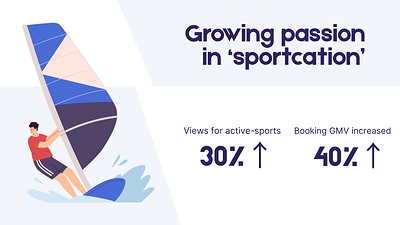
Total travel booking GMV has increased by almost 40%, with markets such as South Korea (+150%), Singapore (+104%), and Thailand (+200%) seeing bookings more than double over the past year. The same is seen for European travellers. The United Kingdom saw bookings grow by over 100%, and Germany by over 600%, highlighting that travellers are increasingly planning holidays around experiences that get them moving.
From adrenaline to adventure, travellers are following their passions
Active travel is taking many forms, reflecting the wide range of interests shaping today's holidays. Globally, diving ranks as the most-booked sporting experience, followed by activities such as ziplining, paragliding, skydiving and cycling.

Across individual markets, preferences vary, giving destinations their own unique sporting identities. Adventure activities prove especially popular across Asia. Diving leads bookings in South Korea, Malaysia, Germany, Spain, Italy and France. At the same time, skydiving ranks first in Hong Kong, Taiwan and Thailand, while Japanese travellers show the strongest preference for cycling.
Destinations are driving signature experiences
As travellers increasingly build holidays around the activities they love, certain places are emerging as go-to destinations for particular passions. The data shows that five destinations in particular stand out across multiple types of active travel, with Thailand, China, Australia, New Zealand and Malaysia appearing among the leading destinations across cycling, climbing, swimming, water sports and adventure experiences.
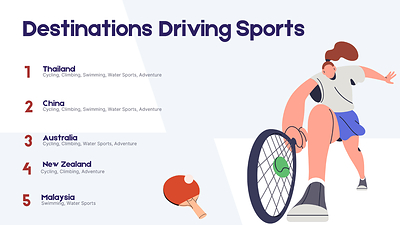
Thailand leads the way, appearing across all five categories and ranking as the leading destination for diving, while also featuring among the top destinations for cycling, water sports and adventure activities. This breadth of experiences makes it a particularly strong destination for travellers looking to combine different activities within one trip.
Australia stands out as another versatile destination, attracting travellers for cycling, rock climbing, surfing and kayaking, as well as adventure activities such as paragliding and skydiving. Its presence across multiple categories reflects the growing appeal of destinations where travellers can combine diverse active experiences within the same holiday.
From travelling together to inspiring others
While the passion for active experiences is shared globally, the way people travel differs across regions. In Europe, the average travel party is 1-2 people, suggesting many travellers are embarking on solo adventures or trips with a partner. Across the Asia-Pacific region, the average group size increases to 2-3, highlighting the popularity of travelling with friends and family to share new experiences.

These experiences are also shaping how travellers engage online. Active travel-related posts on Trip.Moments have nearly doubled globally, growing by 99% year on year as more travellers document their adventures and inspire others to follow in their footsteps. Several markets have seen particularly strong growth in community sharing, including Spain (224.9%), the United Kingdom (122.2%), Italy (118.9%), China (96.2%) and France (86.9%), reflecting the growing popularity of active travel across both Asia and Europe.
The conversations are becoming more engaging, too. While the number of posts has nearly doubled, comments have grown twelvefold compared with the previous year, demonstrating that active travel is encouraging richer conversations rather than simply more content. From destination tips to training advice and first-hand recommendations, travellers are helping one another discover their next active escape, creating a cycle where inspiration leads to bookings and every journey inspires the next.
As travellers continue looking for more meaningful ways to explore the world, active travel is evolving from a niche interest into a mainstream travel trend. Whether it is mastering a new skill, training for a personal goal or simply enjoying the outdoors, active experiences are helping people build stronger connections with destinations and with each other.
About Trip.com Group
Trip.com Group is a global travel service provider comprising of Trip.com, Ctrip, Skyscanner, and Qunar. Across its platforms, Trip.com Group helps travellers around the world make informed and cost-effective bookings for travel products and services and enables partners to connect their offerings with users through the aggregation of travel-related content and resources, and an advanced transaction platform consisting of apps, websites and 24/7 customer service centres. Founded in 1999 and listed on NASDAQ in 2003 and HKEX in 2021, Trip.com Group is on the mission "to pursue the perfect trip for a better world". Find out more about Trip.com Group here: group.trip.com.
Follow us on: X, Facebook, LinkedIn, and YouTube.

 View original content to download multimedia:https://www.prnewswire.co.uk/news-releases/growing-sportcation-travel-trend-tripcom-group-reports-40-increase-in-active-travel-booking-gmv-302864622.html

Das Schweizer Studio Urban Games bringt seine erfolgreiche Verkehrssimulation in die nächste Runde: Transport Fever 3 ist ab sofort erhältlich – erstmals auch in einer Version für macOS. Spielerinnen und Spieler bauen darin über mehr als 125 Jahre Transportgeschichte hinweg ein eigenes Verkehrs- und Logistikimperium auf, von den ersten Pferdekutschen und Dampflokomotiven bis hin zu modernen Düsenjets, Supertankern, Hochgeschwindigkeitszügen und Helikoptern. Der Titel setzt damit die Tradition von Genre-Klassikern wie Transport Tycoon fort und positioniert sich erneut als Konkurrenz zu Städten-Simulationen wie Cities: Skylines, allerdings mit klarem Fokus auf Transport und industrielle Verknüpfungen.
Auf dem Mac richtet sich Transport Fever 3 klar an Besitzer aktueller Hardware. Urban Games verlangt mindestens einen M2‑Pro‑Chip, 16 Gigabyte Arbeitsspeicher, 90 Gigabyte freien Speicherplatz und macOS Sequoia 15. Empfohlen wird ein M4 Pro oder besser mit mindestens 24 Gigabyte RAM. Vertrieben wird das Spiel über Steam und GOG, die Einstiegsversion kostet ab 49,99 Euro. Ob zusätzlich eine Veröffentlichung im Mac App Store geplant ist, ist noch offen. Die Simulation bietet eine deutschsprachige Benutzeroberfläche und Vertonung; Videoeinblicke in das Spiel stellt der Entwickler auf YouTube bereit.
Inhaltlich bleibt Transport Fever 3 dem Kern des Genres treu, vertieft aber die Komplexität. Spieler verbinden Städte und Industrie-Standorte, organisieren Linien für Busse, Straßenbahnen, Lkw, Eisenbahnen, Schiffe, Flugzeuge und Helikopter und optimieren so den Transport von Personen und Gütern. Einnahmen generieren alle Transporte, doch zugleich steigen mit jedem Fahrzeug und jeder neuen Strecke die laufenden Kosten. Zusätzlich müssen mehrstufige Produktionsketten bedacht werden: Rohstoffe wie Holz gelangen zunächst ins Sägewerk, bevor sie als weiterverarbeitetes Produkt in die Städte geliefert werden. Fehler in der Planung oder ungenaue Umsetzung können dazu führen, dass sich Systeme gegenseitig blockieren – etwa bei langen Verbindungen über mehrere Kilometer oder im dicht getakteten innerstädtischen Verkehr.
Transport Fever 3 adressiert diese Komplexität mit einem stärker geführten Einstieg und Szenarien. Eine Einführung erläutert Schritt für Schritt grundlegende Mechaniken wie Straßenbau, Linienplanung und Fahrzeugkauf. Spezielle Szenarien führen anschließend in kompakter Form durch komplexere Zusammenhänge und setzen auf abgeschlossene, erzählerisch eingebettete Aufgaben – etwa wenn eine Stadt für einen Großanlass wie Mardi Gras vorbereitet oder ein Dorf bei der wirtschaftlichen Entwicklung unterstützt werden soll. Das Spiel legt dabei Wert auf Detailsteuerung bis hin zu Ampelphasen an Kreuzungen und erlaubt es, ein fein verzweigtes Netz aufzubauen, in dem erfahrene Spieler jede Linie und jeden Zug kennen. Besitzer von Transport Fever 2 erhalten beim Kauf der Standard- oder Deluxe-Edition auf derselben Plattform einen Treuerabatt von 10 Prozent – ein Angebot, das die bestehende Community in die neue Version mitnehmen soll.