BRASILIA, Brazil, April 22, 2026 /PRNewswire/ -- To really grasp what Cristian Ribera and Aline Rocha pulled off at the Paralympic Winter Games Milano Cortina 2026, you have to look at the ground they train on. Hint: it's not snow.
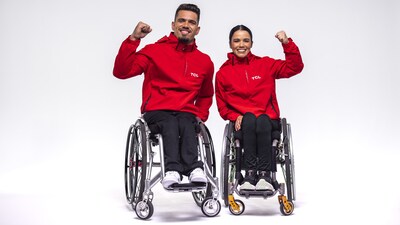
Ribera, 23, recently made history by securing a silver medal in the Men's Sprint Sitting cross-country skiing event—becoming the first South American athlete ever to reach a Winter Paralympic Games podium. Rocha grabbed an impressive 5th-place finish in the Women's Sprint Sitting, setting a new benchmark for Brazilian women.
Cheering on their success was TCL, the Worldwide Olympic and Paralympic Partner in the Home Audiovisual Equipment and Home Appliances category, which supports Ribera and Rocha as part of Team TCL. The lineup includes other world-renowned athletes such as freestyle skier Eileen Gu and snowboarder Ayumu Hirano. Each embodies the drive to push further, echoing TCL's own commitment to empower people to pursue greatness in their own lives.
For Ribera and Rocha, that journey to greatness began not on icy peaks, but on the sun-baked pavement back home.
"In Brazil, we train using roller skis, which are widely used in Europe during the summer," Ribera says. "We train almost all year round on asphalt, and that is very similar to what we do on snow. To give you an idea, last year I trained around 5,000 kilometers. So we train a lot in order to arrive on the snow ready to perform and adapt quickly."
Taking that raw, dry-land power onto the snow is a massive shock to the system. On pavement, athletes use their poles simply to push forward. On snow, the gear is hypersensitive—a balancing act that takes years of bruising practice to nail down.
Then, there is the environment. When Ribera first hit the Swedish snow for training in December 2016, the Nordic winter delivered a jarring culture shock.
"I remember my first training session: it was around 2:30 or 3:00 in the afternoon, and it was already dark," Ribera recalls. "That was very strange for me, because in Brazil during the summer we have sunlight until around 7:00 p.m. It was a very different experience, but a very good one."
Rocha's initiation was even harsher. At her first international event in Ukraine, the thermometer plunged to -28°C. She crashed repeatedly, fighting through conditions totally alien to her background. But she crossed the finish line anyway, effectively pushing the door open for other Brazilian Paralympians to chase the Winter Paralympics circuit.
Ahead of Milano Cortina 2026, the two got a massive boost when TCL, a leading global technology company, stepped in to sponsor them. The move was part of the brand's support to elevate how people enjoy the Olympic and Paralympic Games. This included providing expertise and equipment to the International Broadcast Centre to support the smooth delivery of a seamless viewing experience, as well as smart appliances such as washing machines that enhanced the comfort of the Olympic Village. TCL even prepared a suite of televisions tested to withstand the event's challenging conditions so that athletes could connect with loved ones after each event as part of the Athlete Moment.
The sponsorship was a rare win in a sport where athletes usually spend much of their time just hunting for funding.
"When TCL contacted me on Instagram, I even thought it might be fake," Ribera says. "But when I realized it was real, I was very happy. It was the first major brand to reach out to us. Receiving that support one year before Milano Cortina 2026 gave us even more motivation and showed that our work and our results were being recognized."
While consumer technology doesn't make a carbon-fiber sit-ski glide faster, the brand's support fundamentally changed how both athletes operate on a daily basis.
"TCL's large-screen Mini LED TVs, with their incredible clarity, help us watch our training sessions and analyze our technique, seeing where we can improve," Ribera explains. Practical appliances from TCL such as air conditioners, refrigerators, washers, dryers and more, have helped the athletes optimize their home routines to focus on their training. More than the hardware, though, the psychological lift propelled them to success. "The mental impact is very strong, because now we can say that we are TCL partners. That makes a difference. We have a big team behind us."
Having a global brand in their corner ties directly into TCL's core mission to "Inspire Greatness"—something both athletes already live by. Rocha doesn't divide her life by the car accident that put her in a wheelchair; she divides it into "before and after sport." Sport gave her independence, a chance to travel the world, and a powerful platform.
Now, she's passing that platform on. After watching Rocha and Ribera compete, a 12-year-old girl in Brazil recently decided to try wheelchair sports. To get her started, Rocha's husband and coach is actually restoring Rocha's very first racing chair so the young girl can use it.
"The most important thing is to show other children and other people that we can do whatever we want," Ribera says. "Just because we are in a wheelchair does not mean we cannot achieve our dreams. The first big battle is believing that you can do it."
With historic performances in Milan now in the rearview, neither athlete is taking a breather. Along with TCL, they are already eyeing the Paralympic Games Los Angeles 2028 for wheelchair athletics, while keeping a firm grip on the next winter cycle.
"In 2030," Ribera promises, "we are going after even more medals."

Photo - https://mma.prnewswire.com/media/2962920/Photo_1_for_release.jpg
Logo - https://mma.prnewswire.com/media/2748692/5931178/Picture1__1_Logo.jpg
 View original content:https://www.prnewswire.co.uk/news-releases/from-asphalt-to-the-alps-how-brazilian-paralympians-redefined-winter-sports-supported-as-part-of-team-tcl-302749933.html

Wie stark der Verkehr in einer Stadt stockt, hängt weit weniger allein von der Leistungsfähigkeit des Strassennetzes ab als bislang angenommen. Eine Studie der ETH Zürich und der University of Wisconsin, veröffentlicht in der Fachzeitschrift «Nature Communications», zeigt: Entscheidend ist, wie Wohn-, Arbeits- und Freizeitquartiere räumlich angeordnet sind. Die Forschenden um den Geoinformatiker Yatao Zhang haben 30 Grossstädte weltweit – von Singapur bis Zürich – miteinander verglichen und dabei nicht nur Knotenpunkte und Verkehrsströme auf Strassen, sondern auch Bebauungsdichte, Quartiersstrukturen, Grünflächen und die Nutzung von Flächen für Wohnen, Einkauf, Sport, Verwaltung oder Bildung ausgewertet.
Für ihre Analyse griffen die Wissenschaftlerinnen und Wissenschaftler auf Staudaten des niederländischen Unternehmens Here Technologies zurück, das Bewegungsdaten von Fahrzeugen im Fünf-Minuten-Takt erfasst. Mit einer eigens entwickelten Methode konnten sie die wechselseitige Beeinflussung von Stadtmerkmalen und Verkehr über die Zeit hinweg beschreiben und erstmals robuste Ursache-Wirkung-Beziehungen identifizieren. Demnach führt etwa eine zersiedelte Stadtstruktur tendenziell zu mehr Verkehr, weil Distanzen länger werden und Alltagswege häufiger mit dem Auto zurückgelegt werden. Umgekehrt kann eine Mischnutzung von Wohnen und Arbeiten die Pendlerstrecken verkürzen und das Verkehrsaufkommen senken.
Die Befunde lassen sich konkret illustrieren: Ballungen von Freizeit- und Einkaufsangeboten in einzelnen Quartieren erhöhen den Wochenendverkehr, etwa durch Sportanlagen oder grosse Einkaufszentren. In Singapur etwa verstärkt die räumliche Trennung von grossen Wohngebieten und einem Dienstleistungszentrum die Kopplung zwischen Städtebau und Pendlerströmen deutlich. In Zürich ist dieser Zusammenhang laut Studie weniger ausgeprägt. «Verkehr entsteht durch das, was Menschen tun, nicht allein durch die Existenz von Strassen», fasst Erstautor Zhang die Ergebnisse zusammen.
Aus Sicht der Forschenden könnte die neue Methode mittelfristig die Stadt- und Verkehrsplanung beeinflussen. Werden die Erkenntnisse mit Detailstudien einzelner Städte kombiniert, lassen sich Szenarien simulieren: So kann etwa abgeschätzt werden, wie sich der Ausbau eines S-Bahn-Netzes auf Wohnungsbau in der Agglomeration auswirkt – und umgekehrt, wie ein rascher Anstieg von Neubauten in Vororten den Bedarf an zusätzlicher Verkehrsinfrastruktur nach sich zieht. Angesichts immer komplexerer Städte und wachsender Belastung der Verkehrssysteme sehen die Autorinnen und Autoren ein zentrales Ziel darin, Mobilität und Stadtentwicklung gemeinsam zu denken, um urbane Zentren nachhaltiger gestalten zu können.