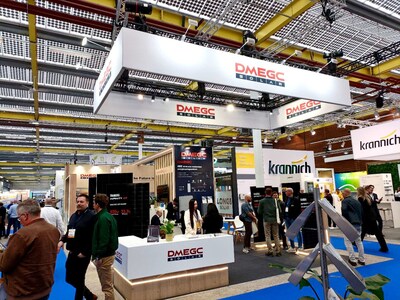
JINHUA, China, March 16, 2026 /PRNewswire/ -- During the recent exhibitions ENEX 2026 in Poland, KEY Energy in Italy, and Solar Solutions Amsterdam, DMEGC Solar demonstrated its latest product portfolio covering residential, commercial & industrial (C&I), utility, and Agri-PV applications, reflecting its commitment to delivering high-efficiency, reliable, and aesthetically pleasing solutions tailored to the evolving demands of the European market.
Aesthetic Power for Rooftops: The G12RT-G48HBB Full Black Module
Standing out in the residential and small commercial segment is the G12RT-G48HBB, a full black N-type monofacial double-glass module. It boasts a remarkable maximum power output of up to 475W and a conversion efficiency of 23.8%, with its main power class set at 465W in Q1 2026. This performance boost is largely attributed to its innovative encapsulation technology, which uses black EVA on the rear side to create additional internal reflection, increasing performance by +1%.
Engineered with aesthetics and durability in mind, the module utilizes DMEGC's Advanced Black Technology to ensure a consistent, deep-black finish that seamlessly integrates with modern architecture. Its robust 2x2 mm double-glass construction provides exceptional mechanical strength, withstanding front loads of up to 5400 Pa and rear loads of 2400 Pa, making it ideal for regions exposed to snow and wind.
High-Power Utility Solution: The INFINITY RT 3.0 650W Module
For utility-scale projects, DMEGC Solar introduced the INFINITY RT 3.0 (G12RT-B66HSW), a high-power module achieving 650W output and 24.1% efficiency in mass production. Built on the N-type platform with high-density encapsulation technology, it offers significant advantages over competing technologies.
The module boasts a high bifacial factor, achieving 5% higher bifaciality than conventional N-type modules and 10% higher than BC modules. Its superior low-light performance contributes to a 0.74% increase in energy yield, leading to a 1.71% higher power generation per kilowatt compared to BC products. This translates to a lower Levelized Cost of Electricity (LCOE), reducing it by approximately 0.6–1% compared to same-sized BC modules. An ultra-sealed adhesive-bonded structure enhances its resilience in high-temperature and high-humidity environments, ensuring its 30-year power performance warranty.
Installer-Friendly Innovation: The Compact M10T-B32HBT
Addressing the challenges of complex residential installations, DMEGC Solar also displayed the M10T-B32HBT, a compact double-glass module designed specifically for easy handling. With dimensions of 1542 x 766 x 30 mm and a low weight of only 15.3 kg, it significantly reduces the physical demands on installers compared to conventional 22-25 kg modules.
Despite its smaller size, the module does not compromise on performance or durability. It allows for optimal roof space utilization, increasing PV roof coverage by up to +2 kW compared to typical 54-cell modules.
Versatility and Certification: The Greenhouse Series
DMEGC Solar also highlighted its Greenhouse series modules, which currently include nine different specifications. These modules cover various sizes and transparency levels, making them suitable for diverse Agri-PV applications such as flower greenhouses, vineyards, and pastures, as well as carports, pergolas, and other installations with overhead requirements.
Reinforcing its leadership in this niche, DMEGC Solar has received the prestigious DIBt certification for overhead applications, which confirms compliance with the highest safety and quality standards for construction-related use, underscoring DMEGC Solar's responsiveness to industry needs, providing forward-thinking, certified solutions for the growing market in the DACH region, BENELUX, and France.
With 46 years of industry experience and cumulative global shipments exceeding 60GW, DMEGC Solar continues to solidify its position as an innovator and a responsible player in the global solar industry. In the BloombergNEF Global Tier 1 PV Module Manufacturers List for Q1 2026, DMEGC Solar secured its place for the eighth consecutive year, reaffirming its global brand influence and project financing capabilities.
 View original content:https://www.prnewswire.co.uk/news-releases/dmegc-solar-displays-new-pv-innovations-across-european-exhibitions-302714445.html


Die Schweizer Großbank UBS steht vor einem deutlich strengeren Kapitalregime. Der Bundesrat will Mitte April eine Verschärfung der Eigenmittelverordnung für systemrelevante Institute beschließen und damit die Anforderungen an die „Too-big-to-fail“-Banken erhöhen. Grundlage sind Vorschläge aus dem Vernehmlassungsverfahren, die vorsehen, dass bestimmte Bilanzposten künftig nicht mehr als hartes Eigenkapital angerechnet werden dürfen. Die Maßnahmen zielen darauf ab, die Widerstandsfähigkeit des Finanzsystems zu stärken und potenzielle Risiken besser abzufedern.
Kern der geplanten Verordnungsänderung ist, dass systemrelevante Schweizer Finanzinstitute ihre Banken-Software sowie latente Steueransprüche (Deferred Tax Assets, DTA) nicht mehr zum Eigenkapital zählen dürfen. Die revidierte Eigenmittelverordnung soll laut den vorliegenden Plänen Anfang 2027 in Kraft treten. Für UBS könnten sich daraus nach eigenen Berechnungen Milliardenbelastungen ergeben, da die Bank ihre Kapitalbasis an die neuen Vorgaben anpassen müsste.
UBS hatte sich bereits im vergangenen Herbst vehement gegen die Pläne gestellt und die Vorschläge als „unverhältnismäßig“ kritisiert. Die Bank verweist darauf, dass ihre Software einen klaren wirtschaftlichen Wert darstelle. Zudem betont UBS, ein vollständiger Abzug latenter Steueransprüche vom Eigenkapital werde in keinem anderen Land angewandt und führe zu einer spürbaren Benachteiligung gegenüber der internationalen Konkurrenz. Nach Darstellung der Großbank würden sämtliche geplanten Verschärfungen ein zusätzliches Eigenkapitalerfordernis im Umfang von rund 26 Milliarden US-Dollar nach sich ziehen.
Trotz der Einwände scheint Finanzministerin Karin Keller-Sutter im Bundesrat eine breite Unterstützung zu haben. Laut Medienberichten tragen neben den beiden SP-Bundesrätinnen und -Bundesräten Elisabeth Baume-Schneider und Beat Jans auch Außenminister Ignazio Cassis (FDP) sowie Mitte-Vertreter Martin Pfister den Kurs mit. Zudem könnten demnach auch die beiden SVP-Bundesräte Albert Rösti und Guy Parmelin die Verschärfungen unterstützen. Parallel zur Verordnung plant die Regierung, dem Parlament eine Botschaft zur Änderung des Bankengesetzes zu unterbreiten. Zentraler Punkt dieser Vorlage ist die vollständige Kapitalunterlegung der ausländischen Tochtergesellschaften der Großbank, gegen die sich UBS ebenfalls gestellt hat. Anders als die Eigenmittelverordnung, die der Bundesrat im Alleingang erlassen kann, unterliegt die Gesetzesrevision der parlamentarischen Beratung und kann im politischen Prozess noch angepasst werden.