Uniting accelerated computing, simulation-validated deployment and AI governance into one continuous AI factory platform
SEOUL, South Korea, Sept. 3, 2026 /PRNewswire/ -- At ASUS AI Tech 2026, ASUS today redefined AI infrastructure from systems that run AI to platforms that build and operate AI factories. Working with NVIDIA and a growing ecosystem of technology partners — including Aleria, AMD, Crusoe, Foxlink, IBM, Intel, Samsung, Schneider Electric and WD — ASUS is enabling enterprises to move beyond standalone infrastructure to production-ready AI factories where performance, operational resilience and AI governance are engineered across the entire lifecycle.
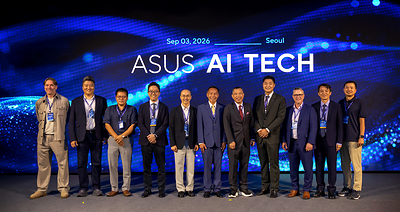
ASUS also reinforced its unified AI infrastructure platform spanning accelerated computing, networking, storage, deployment software, AI operations and governance. By integrating infrastructure engineering, deployment and operational intelligence into a continuous platform, ASUS helps organizations shorten time to first token, accelerate time to revenue and optimize infrastructure efficiency while maintaining trusted AI at scale. This strategic evolution solidifies the role of ASUS as a pivotal end-to-end AI infrastructure partner, transforming computing capacity into tangible, business-driving AI innovation.
"ASUS is now comprehensively embracing its All in on AI strategic initiative, dedicated to embedding AI across infrastructure, commercial solutions, and innovative physical devices. As AI factories evolve into always-on production environments, infrastructure performance and AI governance can no longer be addressed separately. Infrastructure is the foundation of AI production itself. From the decisions that shape the first token to the controls that govern AI at scale, ASUS is engineering for what comes next—bringing compute, connectivity, power, cooling and automation together to turn every watt, every dollar and every minute invested into AI output." said Paul Ju, Senior Vice President, Head of Infrastructure Solution Business Group, ASUS.
AI governance starts before the first token
Building a trusted AI factory begins long before the first model is deployed. ASUS combines advanced system engineering with the NVIDIA DSX Sim Blueprint to help enterprises design, simulate, validate and optimize complete AI factories before physical deployment. Working with ecosystem partners including Schneider Electric, AVEVA and IBM, ASUS brings compute, networking, storage, power, cooling and facility infrastructure into a unified digital twin environment, enabling organizations to identify constraints, optimize configurations and reduce deployment risk before installation begins.
Once deployed, governance extends throughout AI operations. As agentic AI and physical AI become increasingly autonomous, organizations require continuous visibility, oversight, and operational control across models, data, tools and enterprise systems. Beyond the infrastructure management platforms, ACC (ASUS Control Center) and AIDC (ASUS Infrastructure Deployment Center), ASUS significantly extends these capabilities through its comprehensive AI Software Stack and Turnkey AI Applications. Within the AI Software Stack, customers gain direct access to essential tools such as Quota & Billing and an MLOps Portal. These facilitate efficient resource management within the data center, thereby accelerating overall operational speed. At the application level, the AI Software Stack acts as a crucial operational layer and cross-platform software stack. It functions as an 'operational harness', connecting enterprise governance directly with AI services and autonomous agents, enabling secure, manageable, and production-ready deployment of agentic AI.
Backed by advanced integration capabilities and a long-standing collaboration with NVIDIA, ASUS enables enterprises to accelerate AI from design to deployment and ongoing operations. Strong business growth reflects increasing market demand for integrated AI infrastructure that shortens time to first token, accelerates time to revenue and supports AI factories ranging from frontier-scale model development to enterprise, agentic and edge AI deployments.
Customer applications and AI factory implementation
Beyond foundational infrastructure, ASUS showcased AI's tangible impact through key partner demonstrations, illustrating real-world applications and emerging AI paradigms. Foxlink demonstrated next-level industrial automation with autonomous robotics, while Aleria highlighted the critical need for Sovereign AI deployments designed to support localized data control and secure operations. This holistic approach, combined with robust ASUS software-hardware integration and Kubernetes platforms, significantly shortens time-to-revenue for our customers. The ASUS vision extends beyond merely selling computing power; we deliver operational AI factories designed to continuously generate business value and drive the token economy.
Accelerating AI adoption for transformative growth
Looking ahead, ASUS is committed to continuously deepening its collaboration with NVIDIA and a growing global ecosystem of technology partners. By integrating accelerated computing, simulation-validated deployment, and AI harness engineering into one continuous governance framework, we empower organizations to protect their infrastructure investments and maintain control as AI applications grow in complexity and autonomy. Our overarching goal is to help enterprises transition from simply investing in AI to embedding intelligence across their entire operations. This strategic shift is designed to shorten time to revenue, improve efficiency of tokens per watt, significantly reduce resource waste and TCO, and ultimately build AI Factories engineered for peak performance, designed for adaptability, and governed for scalable growth.
AVAILABILITY & PRICING
ASUS servers are available worldwide. However, the availability of certain other ASUS products is subject to local regulatory requirements. For specific product availability and offerings in your region, please contact your local ASUS representative.
 View original content to download multimedia:https://www.prnewswire.co.uk/news-releases/asus-advances-ai-factories-with-integrated-infrastructure-and-operational-governance-302869213.html

Während die Dieselpreise in Teilen Italiens neue Höchststände erreichen, zeichnet sich in Luxemburg eine spürbare Entspannung ab – und in Deutschland profitieren Autofahrer nur eingeschränkt von Steuererleichterungen. In Südtirol kletterte der Dieselhöchstpreis in Bozen Medienberichten zufolge auf 2,288 Euro pro Liter und lag damit am Mittwoch über dem Durchschnitt auf den italienischen Autobahnen. Dort wurden im Schnitt 2,287 Euro pro Liter Diesel fällig. Im gesamtstaatlichen Vergleich ist Südtirol damit weiterhin Spitzenreiter bei den Preisen.
Auch in anderen italienischen Regionen zogen die Dieselpreise deutlich an. In Trient stieg der Selbstbedienungspreis auf 2,274 Euro pro Liter, ein Anstieg um 1,1 Cent binnen eines Tages. Die stärksten Preissprünge wurden jedoch nicht in den teuersten Regionen verzeichnet, sondern im Nordosten und im Westen des Landes: In Friaul verteuerte sich ein einmaliges Volltanken von 50 Litern Diesel um 1,25 Euro, in Ligurien um 1,20 Euro, im Latium um 1,15 Euro. Auf den Autobahnen wurden Tagesanstiege von bis zu zwei Cent je Liter registriert. Der Präsident der nationalen Verbraucherunion, Massimiliano Dona, wirft der Regierung in Rom vor, zu wenig gegen die Preisanstiege zu unternehmen, und warnt vor möglichen Folgen für die Inflation.
Parallel dazu zeigt sich in Luxemburg ein gegenteiliger Trend. Dort wird Diesel nach Angaben des Wirtschaftsministeriums ab Mitternacht um 6,2 Cent je Liter günstiger und kostet dann 1,995 Euro. Damit fällt der Preis unter die Marke von zwei Euro. Die Benzinsorten Super 95 und Super 98 bleiben stabil bei 1,837 Euro beziehungsweise 2,049 Euro je Liter. Auch Heizöl wird in Luxemburg billiger: Bei Abnahme von mindestens 1.500 Litern sinkt der Literpreis am Mittwoch ebenfalls um 6,2 Cent auf 1,477 Euro. Der Großherzogtum bewegt sich damit preislich klar unter dem Niveau vieler Regionen in Italien.
In Deutschland wiederum kommt eine bereits beschlossene Steuerentlastung für Autofahrer nur begrenzt an. In Sachsen-Anhalt senkte die Bundesregierung vor rund einer Woche die Steuern auf Kraftstoffe um 17 Cent pro Liter. Laut dem Portal Benzinpreis-blitz kostete Super E10 am Mittwochnachmittag im Landesdurchschnitt 2,12 Euro pro Liter und damit lediglich rund sieben Cent weniger als am Nachmittag vor Inkrafttreten des Rabatts. Der Dieselpreis lag bei 2,19 Euro pro Liter, rund 15 Cent unter dem Vorkrisenniveau. Die Entlastung erreicht damit nicht vollständig die angekündigte Höhe, zudem spielt laut den Erhebungen die Uhrzeit eine wesentliche Rolle: Je nach Tageszeit fällt der Vorteil für Verbraucher unterschiedlich aus.
Im europäischen Vergleich entstehen damit deutliche Preisunterschiede für Dieselverbraucher. Während Italien mit Rekordständen in Teilen des Landes und spürbaren Tagesanstiegen im Fokus steht, nutzt Luxemburg den Spielraum für Preissenkungen. Deutschland versucht, über Steuersenkungen gegenzusteuern, bislang mit begrenzter Durchschlagskraft an der Zapfsäule. Für Verbraucher bleibt das Umfeld volatil – und die Frage, in welchem Umfang staatliche Eingriffe und Marktbewegungen künftig tatsächlich im Portemonnaie der Autofahrer ankommen.